Introduction
India has over 14 million retail outlets — the second-largest retail network in the world — yet most consumers make purchase decisions before they ever walk through a store door. Reaching them at the right moment, on the right channel, is what separates brands that grow from brands that get ignored.
Retail advertising covers all paid and strategic promotional activities that build awareness, generate footfall, and convert browsers into buyers. In India, where newspaper readership totals 29.1 million print copies in circulation and digital adoption is accelerating simultaneously, effective retail advertising requires balancing trust-building print media with precision-targeted digital campaigns.
Neither channel works in isolation. The retailers seeing the strongest results are the ones treating both as complementary, not competing.
This complete guide covers what retail advertising is, the five main types (print, digital, in-store, outdoor, and experiential), the key benefits it delivers, and real-world examples from India's festive advertising landscape to inspire your next campaign.
Key Takeaways
- Retail advertising drives product awareness and sales through paid, strategic promotion across multiple channels
- Five core formats: print, digital, in-store displays, outdoor/OOH, and experiential marketing
- Delivers measurable benefits: stronger brand visibility, higher footfall, and trackable ROI
- Most effective when channels are chosen based on audience, geography, and timing
What is Retail Advertising?
Retail advertising refers to the paid, strategic promotional activities that retailers use to communicate their products, services, or offers to potential and existing customers. The primary goal is driving awareness, footfall, and sales at the point of purchase — whether in-store or online.
Unlike brand advertising, which builds long-term identity and emotional connection through storytelling, retail advertising is focused on immediate consumer action. A retail ad typically includes specific offers (20% off), urgency (limited-time sale), and clear calls-to-action (visit our store today, shop now online).
Retail Advertising vs. Retail Marketing
Retail marketing is the broader strategic umbrella covering pricing, store design, product selection, customer service, and promotional activities. Retail advertising is a specific subset within this umbrella — the paid or strategic messaging delivered via media channels (newspapers, digital platforms, outdoor hoardings, in-store displays).
This distinction matters for budget planning and measurement. Knowing what counts as "advertising" versus other retail investments helps businesses allocate resources accurately and track returns on promotional spend separately from broader operational costs.
The Evolution of Retail Advertising in India
Retail advertising in India has shifted dramatically from purely print-based methods to a multi-channel environment. Today's retail campaigns span:
- Newspaper classifieds and inserts (still widely used in regional markets)
- Digital display and programmatic ads
- Social media promotions
- In-store digital screens and DOOH placements
Yet unlike Western markets where print has declined sharply, print advertising in India has held its ground.
India recorded 29.1 million newspaper copies in circulation during H2 2025, with approximately 2% growth on a like-to-like basis — even as global print markets contracted by 7%. Indian readers spend an average of 56 minutes per day reading print press, compared to 39 minutes in North America and just 29 minutes in Europe.
This trust in print is particularly strong in regional and vernacular markets. Hindi and other vernacular newspapers continue growing faster than the overall market, making print a powerful channel for reaching engaged audiences across Tier 2 and Tier 3 cities. For retailers making channel decisions, this data points to one clear conclusion: in India, a multi-channel strategy that includes print isn't optional — it's where reach actually lives.
Types of Retail Advertising
Effective retail advertising isn't about picking a single channel — it's about selecting the right mix based on your audience, geography, budget, and product type. The five major categories below form the foundation of modern retail advertising strategies.
Print Advertising
Print advertising is one of the oldest and most trusted forms of retail advertising, covering newspaper ads (classified and display), magazine inserts, catalogs, pamphlets, and brochures. In India, where regional language newspapers reach tens of millions of highly engaged readers daily, print advertising offers unmatched credibility and recall.
Key advantages of print advertising for retailers:
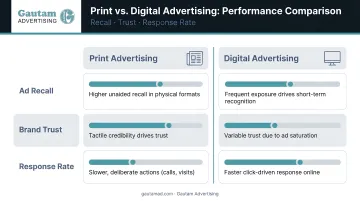
- High Recall Rates: Print ads achieve 78% recall versus 46% for digital ads, according to Newsworks research
- Strong Trust: 82% of consumers trust print ads when making purchasing decisions
- Superior Response Rates: Print achieves 9% response rates compared to approximately 1% for email, search, and social media
- Amplification Effect: Newspapers increase TV ad effectiveness by 64%
Working with an experienced, INS-accredited advertising agency is essential to securing optimal newspaper ad placements and competitive rates across a network of publications. Gautam Advertising, INS-accredited since 1976, draws on relationships with 10,000+ publications built over five decades to secure strong placements and negotiated rates for retailers across India.
Digital Advertising
Digital retail advertising encompasses the paid promotional activities retailers deploy across online channels to reach consumers where they browse, shop, and consume content. Core formats include:
- Social Media Ads (Facebook, Instagram): Carousel ads showcasing product collections, Stories ads for limited-time offers
- Search Engine Marketing (SEM): Google Ads targeting high-intent keywords like "buy running shoes Mumbai"
- Display Banner Ads: Retargeting ads that follow website visitors across the web
- Email Marketing Campaigns: Personalized offers sent to customer databases
- Sponsored Product Listings: Paid placements on e-commerce platforms like Flipkart and Amazon
Digital advertising enables precise audience targeting based on demographics, interests, location, and behavior, with real-time performance tracking that allows retailers to optimize campaigns continuously.
Retargeting deserves special attention in retail digital advertising. Retargeting re-engages users who visited your website or interacted with your brand but didn't complete a purchase. It converts visitors 70% more often than cold traffic, with average conversion rates of 3.8% versus 2.2% for standard campaigns.
Cart abandonment retargeting specifically recovers approximately 26% of abandoned carts and delivers an 8.2:1 ROAS — making it one of the most efficient strategies in a retailer's digital mix.
In-Store Advertising
In-store advertising refers to promotional materials placed within the physical retail environment to influence purchase decisions at the point of sale. Common formats include:
- Shelf talkers and end-cap displays
- Window posters and banners
- Digital signage and video screens
- Point-of-sale (POS) displays
- Floor graphics and aisle directories
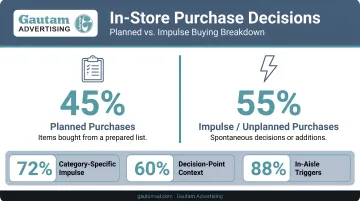
According to the 2012 POPAI Shopper Engagement Study, 76% of purchase decisions are made in-store — not before entering the store. Breaking down further: only 24% of purchases are specifically planned, while 55% are completely unplanned impulse purchases made in the store itself.
In-store advertising works in concert with other channels. A customer might see a newspaper ad announcing a festive sale, then encounter the same messaging through shelf talkers and POS displays inside the store. That repetition reinforces recall and drives conversion precisely when the purchase decision is being made.
Outdoor / OOH Advertising
While in-store materials influence buyers already inside, outdoor advertising (also known as Out-of-Home or OOH) captures them before they arrive. Hoardings, billboards, transit ads, and A-frame signs placed in high-traffic public spaces are particularly effective for building local brand awareness and driving foot traffic to nearby retail locations.
In India, the OOH market is experiencing steady growth, particularly in metro areas like Mumbai, Delhi, and Bangalore where high population density and daily commuter movement create millions of daily impressions. Digital OOH (DOOH) — dynamic screens in malls, airports, and transit hubs — is growing especially rapidly, projected to reach USD 620 million by 2030.
For retailers, outdoor advertising works best when placed strategically near store locations or along routes frequented by target customers, creating repeated brand exposure that translates into store visits.
Experiential Advertising
Experiential advertising creates immersive, participatory experiences that go beyond passive ad viewing. Examples include:
- Product sampling and live demonstrations
- Pop-up shops in high-traffic locations
- Interactive QR-code campaigns linking physical and digital experiences
- In-store events and workshops
- Augmented reality (AR) try-on experiences
This format builds emotional brand connection and drives trial by allowing consumers to experience products firsthand. A cosmetics retailer might host a makeup tutorial event, a food brand might offer tastings at a supermarket, or a fashion retailer might create an Instagram-worthy photo backdrop that encourages social sharing.
Festive seasons amplify this effect — a well-executed Diwali pop-up or sampling event can generate both immediate sales and lasting brand associations that paid ads alone rarely produce.
Key Benefits of Retail Advertising
Increased Brand Visibility
In a crowded retail market, regular advertising keeps your brand top-of-mind for consumers. Consistent exposure across channels builds recognition and trust, making shoppers more likely to choose a familiar brand over an unknown one.
Over 60% of Indian consumers trust print and TV more than digital news, while 72% feel overwhelmed by digital advertising — which makes channel selection critical for building credibility. Retailers that maintain steady visibility through trusted channels earn preference when consumers are ready to purchase.
Driving Foot Traffic and Sales
Retail advertising, especially print ads featuring promotions, seasonal offers, or new arrivals, directly drives consumers into stores or to websites. Time-sensitive offers create urgency that translates to measurable foot traffic and revenue spikes.
During India's 2025 festive season, 43% of consumers planned to spend above ₹20,000, and 45% were open to trying new brands — a clear signal of how festive advertising shapes purchase intent and drives sales.
Reaching the Right Audience
Multi-channel retail advertising allows businesses to target specific demographics with precision. A regional newspaper ad in Gujarat reaches a different, highly relevant audience than a social media ad targeting urban millennials in Bangalore.
Audience-channel alignment is the foundation of efficient ad spend. Retailers targeting senior consumers in Tier 2 or Tier 3 cities often find greater ROI from regional newspaper advertising than from Instagram. Younger, urban audiences, by contrast, respond better to digital display and social media campaigns.
Building Customer Loyalty
Retail advertising isn't only for acquiring new customers — it also reinforces relationships with existing ones. Loyalty-driven campaigns remind past customers why they chose your brand and encourage repeat purchases.
Common tactics include:
- Exclusive subscriber offers announced via newspaper inserts
- Anniversary sale invitations sent via email
- VIP early-access promotions shared with app users
Each of these rewards loyalty and increases customer lifetime value.
Measurable ROI
Unlike general brand campaigns, retail advertising is often tied directly to trackable outcomes — coupon redemptions, store visit increases, or sales during a campaign period.
Setting clear KPIs before launching campaigns (footfall, sales lift, impressions, click-through rates) enables retailers to evaluate performance and refine future ad spend. Retargeting campaigns are 160% more profitable than cold prospecting, demonstrating how measurable data can guide strategic decisions that maximize ROI.
Real-World Examples of Retail Advertising
Example 1: Print Advertising for Festive Sales
A large Indian apparel retailer runs a half-page display ad in The Times of India, Hindustan Times, and regional language papers ahead of Diwali. The ad highlights a "Flat 40% Off Festive Collection" offer with bold product imagery, a clear expiry date, and a "Visit your nearest store" call-to-action.
It works because every element earns its place: the 40% discount is the hook, Diwali timing amplifies urgency, and placement in trusted national newspapers adds credibility that digital-only ads can't replicate.
Example 2: Digital Advertising with Retargeting
A Mumbai-based fashion retailer launches an Instagram carousel ad showcasing its new winter collection. The ad includes a "Shop Now" button driving traffic directly to the e-commerce page. Visitors who browse but don't purchase are retargeted with dynamic product ads featuring the exact items they viewed, plus a 10% discount code to incentivize conversion.
The carousel format does the visual storytelling, the direct checkout link removes friction, and the retargeting layer turns window shoppers into buyers — often at a fraction of the cost of acquiring new customers.
Example 3: In-Store Advertising at Supermarkets
A beverage brand uses colorful shelf displays and end-cap promotions at major supermarket chains to stand out from competitors in the same aisle. The display includes bright signage, product samples, and a QR code linking to a festive recipe collection.
Three things make this approach effective:
- End-cap placement puts the brand at the point of decision, ahead of competitors
- Product samples lower the barrier to trial and drive immediate purchase
- The QR code extends the experience beyond the store, keeping the brand top of mind
Festive Season Context
The examples above share a common thread — timing. Festive seasons (Diwali, Eid, Christmas, New Year) are peak retail advertising moments in India, when print inserts, outdoor hoardings, and digital campaigns combine to reach consumers at their highest intent.
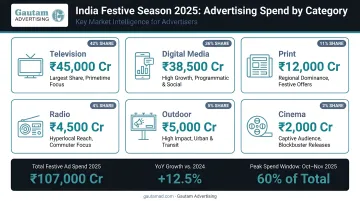
During 2025's festive season, the scale of that spend made the timing stakes clear:
- Total ad spend: ₹48,000–51,000 crore
- Creative spending: up 20%
- Influencer marketing: surged 40%
- Retail media: grew 25–30%
Premium placements sell out fast during these windows. Working with INS-accredited agencies early secures inventory before rates spike and availability narrows.
How to Build a Retail Advertising Strategy
Step 1: Know Your Audience and Choose the Right Channels
The most important first step is understanding where your target customers consume media. A retailer targeting senior consumers in Tier 2 or Tier 3 cities in India may find greater ROI from regional newspaper advertising than from Instagram. Younger, urban audiences may respond better to social media and digital display ads.
Channel selection should follow the audience, not the other way around. Conduct research to understand:
- Demographics: Age, income, language preference, location
- Media Consumption Habits: Which newspapers do they read? Which social platforms do they use?
- Purchase Behavior: Do they research online and buy offline, or vice versa?
Match channels to audience behavior to reach the right people at the right moment.
Step 2: Set Goals, Budget, and Timing
Align advertising spend with specific objectives (brand awareness vs. immediate sales), set a realistic budget, and time campaigns around key retail moments.
Before launching, nail down three things:
- Goal: Are you driving footfall, boosting online sales, opening a new store, or clearing inventory? Each goal calls for different messaging and channel emphasis.
- Budget: Research shows effective campaigns typically allocate 60% to brand building and 40% to sales activation — balancing long-term awareness with short-term promotional push.
- Timing: Align campaigns with festive seasons (Diwali, New Year), product launches, or clearance sales. Working with an INS-accredited media agency — like Gautam Advertising — gives you access to negotiated rates and premium placements across 10,000+ publications.
Step 3: Launch, Measure, and Optimize
Once your campaign is live, track performance against defined KPIs and use the data to sharpen what comes next.
Key performance indicators for retail advertising include:
- Footfall: Store visit increases during campaign period
- Sales Lift: Revenue change compared to pre-campaign baseline
- Impressions & Reach: Total audience exposure
- Conversion Rate: Percentage of ad viewers who purchase
- ROAS (Return on Ad Spend): Revenue generated per rupee spent on advertising
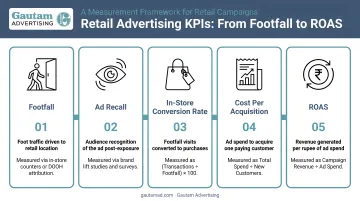
When you know which channels drove the most footfall or conversions, you can shift budget toward what works — and stop spending on what doesn't.
Frequently Asked Questions
What is retail advertising?
Retail advertising encompasses all paid promotional activities retailers use across channels — print, digital, in-store, outdoor, and experiential — to drive product awareness, attract customers, and increase sales. It focuses on immediate consumer action rather than long-term brand storytelling.
Why is retail advertising important?
Retail advertising keeps a brand visible in a competitive marketplace, drives foot traffic and online purchases, and builds customer loyalty through consistent messaging. It also delivers measurable returns through trackable KPIs like sales lift and footfall increases.
What are the main types of advertising used in retail?
Retail advertising spans five main types:
- Print — newspapers, magazines, catalogs
- Digital — social media, SEM, email, display ads
- In-store — POS displays, digital signage
- Outdoor/OOH — billboards, transit advertising
- Experiential — pop-ups, sampling, interactive campaigns
What are examples of retail advertising?
Common examples include a newspaper display ad promoting a Diwali festive sale with a 40% discount, and a social media carousel ad for a new product collection with a "Shop Now" button. In-store shelf displays at supermarkets are another classic example, designed to drive impulse purchases at the point of sale.
What are the 5 P's of retail?
The 5 P's of retail are Product, Price, Place, Promotion, and People. Retail advertising primarily falls under the "Promotion" pillar but is deeply influenced by the other four Ps — particularly price positioning and place, meaning the channels where customers actually shop.
What are the key features of retail marketing?
Effective retail marketing shares several defining features:
- Audience-first thinking — grounded in real customer behavior
- Multi-channel approach — integrating print, digital, and in-store
- Clear calls to action — visit store, buy now, claim offer
- Measurable outcomes — tracking sales lift and footfall
- Consistent brand experience — across all touchpoints to build trust