
Introduction
Placing a print advertisement in India requires more than choosing a publication and writing effective copy. Advertisers must navigate specific content policies, regulatory guidelines, and technical requirements that govern what can and cannot be published. A missing RERA registration number or a file submitted in RGB instead of CMYK can mean rejection, delays, or legal exposure before your ad ever runs.
This guide is for businesses, marketing teams, and brand managers advertising in Indian newspapers or magazines — across recruitment, real estate, finance, legal notices, and consumer products.
We'll cover India's regulatory bodies, content standards, mandatory disclosures, technical submission norms, and category-specific rules that determine whether your ad gets published or rejected.
TLDR:
- Print ads in India are governed by multiple regulatory layers: ASCI, PCI, INS, and category-specific laws
- Certain categories (tobacco, alcohol, pharmaceuticals) face strict advertising bans or disclosure requirements
- Financial results, RERA real estate ads, and legal notices carry mandatory disclosure formats
- Technical specs like PDF/X-1a format, CMYK color mode, and 300 DPI are standard across major publications
- INS-accredited agencies handle pre-submission checks and publication compliance on your behalf
What Is a Print Media Advertisement Policy and Why Does It Exist?
A print media advertisement policy is the set of rules, standards, and guidelines that govern what can and cannot be published as a paid advertisement in newspapers and magazines. These policies are established by both regulatory authorities and individual publications to maintain accountability and protect readers.
These policies serve two purposes: protecting consumers from false, misleading, or harmful advertising content, and preserving the credibility and legal standing of the publications that carry those ads. According to the Advertising Standards Council of India (ASCI), advertisements must be "legal, decent, honest and truthful, and not hazardous or harmful, while observing fairness in competition."
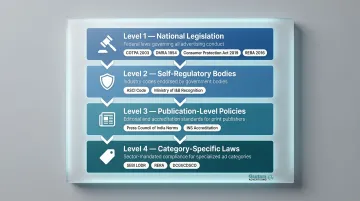
Policies operate at multiple levels simultaneously:
- National legislation — COTPA 2003 (tobacco ban), Drugs and Magic Remedies Act 1954, Consumer Protection Act 2019, RERA Act 2016
- Self-regulatory bodies — ASCI Code for Self-Regulation, recognized by the Ministry of Information and Broadcasting
- Publication-level editorial policies — Press Council of India Norms, INS accreditation framework
- Category-specific laws — SEBI LODR (financial ads), RERA (real estate), DCGI/CDSCO (pharmaceuticals)
Each ad category draws from multiple frameworks at once. A legal notice, for example, must satisfy statutory language requirements under the Civil Procedure Code or Insolvency and Bankruptcy Code. It must also meet PCI norms for advertorial labeling and pass the publication's own acceptance criteria before it runs.
Regulatory Bodies That Govern Print Advertising in India
Advertising Standards Council of India (ASCI)
Established in 1985, ASCI is a voluntary, not-for-profit self-regulatory body that sets and enforces advertising content standards across all media, including print. Though not a government agency, its Code is recognized by the Ministry of Information and Broadcasting.
Under Rule 7(9) of the Cable Television Networks Rules, 1994, no advertisement that violates the ASCI Code is permitted on cable services.
ASCI's Code is structured around four chapters:
- Truthfulness and Honesty
- Public Decency
- Safety and Social Responsibility (including children)
- Fairness in Competition
In the 2024-25 period alone, ASCI reviewed 9,599 cases and processed 7,199 ads for potential Code violations. Compliance responsibility falls on the advertiser, the advertising agency, and the media owner or publisher — all three parties are accountable.
Indian Newspaper Society (INS)
INS represents member newspaper publications and administers the accreditation of advertising agencies in India. The INS Press Handbook (2023-2024 edition) serves as the authoritative reference for member publication details, advertisement rates, accredited agency lists, and media-related information.
INS accreditation establishes a recognized framework of professional standards, with clear obligations on both sides:
- Accredited agencies must provide publications with complete billing details
- Publications must follow obligations regarding agency commissions and rate transparency
Press Council of India (PCI)
Established under the Press Council Act, PCI publishes the Norms of Journalistic Conduct (2022 edition), which includes guidelines for advertisements. Key requirements include:
Advertorial labeling: Advertorials must be printed with the heading "Advertisement/Advertorial" in bold letters, with font size equal to the sub-headings on that page. Supplements must mention "Marketing Initiative."
Prohibited ad categories under PCI norms:
- Ads promoting intoxicants
- Ads violating the Drugs and Magic Remedies Act 1954
- Ads seeking organ donors
- Gaming/matka charts
- Job ads with only phone numbers and no employer details
In February 2024, PCI advised newspapers to verify credentials of firms placing job advertisements and maintain proper advertisement booking policies to contain misleading advertisements.
Central Bureau of Communication (CBC)
The Central Bureau of Communication (CBC), officially renamed from DAVP in June 2022, governs government-issued advertisements. Publications seeking CBC empanelment must meet specific criteria:
- Circulation verified by Audit Bureau of Circulations (ABC) or Registrar of Newspapers for India (RNI)
- Uninterrupted publication for at least 36 months
- Dailies require minimum 8 pages; weeklies/fortnightlies minimum 16 pages
- Point-based marking system awards points for news agency subscriptions (PTI/UNI), own printing press, RNI returns, and EPF subscription
CBC budget allocation is tied to publication size:
| Category | Circulation | Budget Share |
|---|---|---|
| Small | Up to 25,000 copies | 15% |
| Medium | 25,001–75,000 copies | 35% |
| Big | Above 75,000 copies | 50% |
Individual Publication Policies
Beyond national guidelines, individual publications maintain their own internal advertising acceptance policies, often stricter than regulatory requirements. Advertisers should request and review a publication's specific terms and conditions before submitting creative material.
Content Standards and Prohibited Advertising Categories
Truthfulness and Substantiation
ASCI's foundational principle states that all print advertisements must be truthful, honest, and not misleading. Specifically:
- All descriptions, claims, and comparisons relating to objectively ascertainable facts must be capable of substantiation
- Advertisers must produce evidence when called upon by ASCI
- Research-based claims must disclose source and date
- Products cannot be described as "free" if the consumer must pay anything beyond actual delivery/postage costs
- Fine print cannot contradict the main message
Tobacco Advertising — Complete Ban
Section 5 of the Cigarettes and Other Tobacco Products (Prohibition of Advertisement and Regulation of Trade and Commerce, Production, Supply and Distribution) Act (COTPA), 2003 imposes a total ban on tobacco advertising in India.
Key provisions:
- Prohibits any person engaged in production, supply, or distribution from advertising tobacco products
- Directly prohibits newspaper editors and magazine publishers from carrying tobacco advertisements
- Includes "leaflet, hand-bill or document" containing tobacco advertisements
- First conviction: up to 2 years imprisonment and/or fine up to ₹1,000
- Subsequent conviction: up to 5 years imprisonment and fine up to ₹5,000
This applies without exception — general-circulation newspapers and magazines are equally bound.
Alcohol Advertising — State-Level Restrictions
Alcohol advertising in India operates under a fragmented regulatory landscape — individual states hold constitutional power to regulate alcohol under the Seventh Schedule (State List, Entry 8). That said, PCI Norms 2022 apply nationally, explicitly prohibiting advertisements that directly or indirectly promote "production, sale, or consumption of cigarettes, tobacco products, wine, alcohol, liquor, or other intoxicants."
ASCI surrogate advertising guidelines (updated December 2023):
For brand extensions of restricted products (liquor/tobacco) to qualify as genuine (not surrogate), they must meet these criteria:
- Registration with appropriate government authority (GST/FDA/FSSAI/Trademark)
- Brands in market >2 years: sales turnover exceeding ₹5 crore/annum nationally or ₹1 crore/annum per state
- Brands <2 years: net sales of ₹20 lakhs/month, OR ₹10 crore fixed asset investment, OR turnover >10% of parent brand
- Ad spend caps: Years 1-2 max 200% of sales turnover; Year 3 max 100%; Year 4 max 50%; Year 5+ max 30%
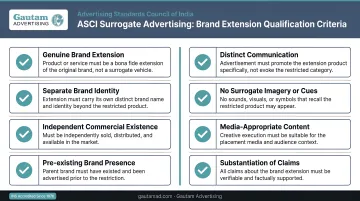
Source: ASCI Guidelines for Qualification of Brand Extension
Pharmaceutical and Health Advertising
Drugs and Magic Remedies (Objectionable Advertisements) Act, 1954 (DMRA):
- Section 3 prohibits advertisements for drugs claiming to treat diseases listed in the Schedule
- Section 4 prohibits misleading advertisements
- "Magic remedies" (talismans, mantras) claiming healing powers are banned
- First offence: up to 6 months imprisonment and/or fine
- Subsequent offence: up to 1 year
Drugs and Cosmetics Act, 1940:
- Schedule J lists diseases for which cure claims are prohibited
- Prescription drugs (Schedules H, H1, X) cannot be advertised to the general public
Following a Supreme Court directive, advertisers must submit a self-declaration certificate through the Press Council of India Portal before publishing health-related advertisements in print media.
Children's Advertising
ASCI Code Chapter III defines children as persons below 12 years. Advertisements addressed to children must not:
- Show them in dangerous situations (playing with matches, knives, electrical appliances)
- Encourage them to converse with strangers
- Feature children for tobacco or alcohol products
- Exploit their innocence or inexperience
- Create a sense of urgency or pressure
Decency and Social Responsibility
Advertisements may not contain content that is obscene, indecent, or likely to cause public offense. They may not use stereotypical, demeaning, or discriminatory depictions on the basis of gender, religion, caste, or ethnicity.
Advertorial Labeling Requirement
Advertorials, sponsored features, and native advertising must be clearly labeled as "Advertisement" or "Advertorial" so readers can distinguish them from editorial content. Failure to do so violates Press Council of India norms and ASCI guidelines.
Mandatory Disclosures and Legal Requirements by Ad Type
Financial and Corporate Advertisement Requirements
Listed companies publishing financial results in newspapers must comply with Regulation 47 of SEBI (LODR) Regulations, 2015 (as amended by Third Amendment Regulations, 2024):
Key requirements:
- Publish advertisement within 48 hours of board meeting approving financial results
- Include QR code and webpage details where complete financial results are accessible
- Publish in at least one English national daily circulating in substantially the whole of India
- Publish in one regional language daily where registered office is situated
- SME Exchange-listed entities are exempt
Following 2024 amendments, publishing full financial results in newspapers is optional — only the QR code and web link are mandatory.
Legal Notice and Public Notice Advertisement Requirements
Several laws mandate newspaper publication for legal and insolvency matters:
- Court summons: CPC Order 5 Rule 20 permits substituted service through newspaper publication when a defendant is found to be intentionally avoiding service
- Insolvency notices: Section 130 of the Insolvency and Bankruptcy Code, 2016 requires public notice inviting creditor claims during resolution; IBBI regulations also mandate newspaper announcements for CIRP and voluntary liquidation proceedings
- Companies Act, 2013: Sections 230, 391, and 66 require newspaper publication for mergers, liquidation, and reduction of share capital respectively
Publications require proof of the legal basis before accepting such ads.
Recruitment Advertising Requirements
Recruitment ads must comply with both constitutional protections and statutory requirements:
- Constitution of India: Article 15 prohibits discrimination on grounds of religion, race, caste, sex, or place of birth; Article 16 guarantees equality of opportunity in public employment
- Equal Remuneration Act, 1976: Section 5 prohibits discrimination in recruitment on the basis of sex
- ASCI guidelines: Job ads must not contain discriminatory language based on gender, religion, caste, or age, and must not make misleading salary or job role claims
Overseas recruitment ads: PCI Norms 2022 require compliance with the Emigration Act, 1983, including registration certificate/permit number, full address (not just P.O. Box), statement that no fee is charged, and salary offered per category.
Real Estate Advertising Compliance Under RERA
RERA Act 2016 — National requirement:
- Section 3 prohibits advertising, marketing, booking, or offering for sale any real estate project without RERA registration
- Section 11(2) requires all advertisements to be consistent with sanctioned plans, layout plans, and specifications approved by the competent authority
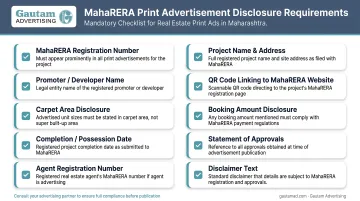
MahaRERA (Maharashtra) — Enhanced requirements:
Order 46/2023 and 46A/2023 mandate:
- QR code in all advertisements (minimum 3cm x 3cm for print)
- QR code must lead to the project's MahaRERA portal page
- MahaRERA registration number and website URL must be at least one-third (33%) the font size of the project name
- Registered real estate agents must quote their agent registration number and project registration number
Penalties: Up to 5% of estimated project cost; typical first-time violation fines range from ₹10,000 to ₹50,000.
Technical Submission Requirements: Formats, Sizes, and Deadlines
Print-Ready File Specifications
Major Indian publications require ads to be submitted in specific technical formats to ensure print quality:
Industry-standard requirements:
- Format: PDF/X-1a (fonts must be embedded)
- Color mode: CMYK (not RGB)
- Resolution: Minimum 300 DPI
- Fonts: All fonts must be embedded in the file
Submitting files in the wrong format is the fastest way to miss a print slot — confirm specs with the publication before sending.
Getting file specs right is only part of the equation. You also need to understand how publications measure and price ad space.
Newspaper Ad Size Measurement Conventions
Column centimeters (cc or col cm) are the standard unit for pricing and measuring variable-size newspaper advertisements in India.
How column centimeters work:
- Calculated as width (in columns) × height (in centimeters)
- Standard column width is approximately 3 cm in major Indian dailies like Times of India
- A 2-column × 10 cm ad = 20 column centimeters
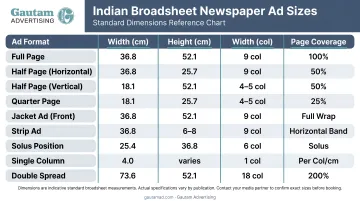
Standard broadsheet ad sizes:
| Ad Format | Dimensions (W × H) |
|---|---|
| Full Page | approx. 32.9 cm × 52 cm |
| Half Page (Vertical) | 16 cm × 46 cm |
| Half Page (Horizontal) | approx. 32.9 cm × 25 cm |
| Quarter Page | 16 cm × 25 cm |
| Skybus (front page strip) | approx. 32.9 cm × 5 cm |
| Minimum classified display | 3 cm × 5 cm |
Once you've confirmed your ad size, the next step is booking within the publication's deadline window.
Booking Deadline Requirements
Publications have defined material deadlines that vary by ad type:
- Classified text ads: Book at least 1 day before the publication date
- Display and color ads: Require 2–7 days advance booking, depending on the newspaper, page position, and format (jacket ads, gatefolds require more lead time)
- Special issues: Anniversary editions, supplements, and themed sections are often booked weeks or months in advance
Missing deadlines bumps your booking to the next available date. To avoid gaps in your campaign, confirm the exact deadline with your publication or agency at the time of booking.
How an INS-Accredited Agency Simplifies Print Ad Compliance
Working with an INS-accredited advertising agency takes much of the guesswork out of India's print media compliance requirements. Accredited agencies maintain established relationships with publications, understand each publication's specific acceptance criteria, and act as a direct interface between advertisers and media houses — cutting ad rejection risk from the start.
Pre-Submission Compliance Checks
Agencies conduct pre-submission reviews covering:
- Reviewing ad content against ASCI guidelines and category-specific regulations
- Confirming mandatory disclosures for regulated categories (RERA registration numbers, SEBI requirements, legal notice statutory language)
- Ensuring files meet technical specifications (PDF/X-1a format, CMYK color mode, 300 DPI resolution, embedded fonts) before submission
- Verifying advertorial labeling and disclosure requirements
This proactive approach saves advertisers time and avoids costly reprints or missed deadlines.
Leveraging Publication Relationships
INS-accredited agencies maintain decades-long relationships with publications, enabling them to:
- Navigate publication-specific acceptance policies that may be stricter than national guidelines
- Secure optimal ad placement for maximum response
- Negotiate competitive rates through established agency-publication frameworks
- Expedite the approval process when time-sensitive campaigns require rapid turnaround
Gautam Advertising's Compliance Expertise
Gautam Advertising, INS-accredited since 1976, brings 55+ years of experience navigating print media compliance across India's regulatory landscape. With a network of 10,000+ publications worldwide, the agency's process-driven approach to media planning includes guiding clients through category-specific requirements for legal notices, financial results, real estate (RERA), recruitment, and corporate announcements.
Regulated categories handled include:
- Legal Notices: Court summons, insolvency notices, and tender notifications
- Corporate Results: SEBI LODR-compliant financial result publications
- Real Estate: RERA-compliant property ads with all mandatory disclosures
- Recruitment: Non-discriminatory job ads meeting constitutional and statutory requirements
- Change of Name: Statutory notices formatted to meet publication standards
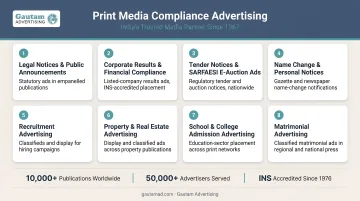
With 50,000+ advertisers served and 100+ active media partnerships, Gautam Advertising's familiarity with each publication's internal requirements means campaigns move from submission to publication without back-and-forth corrections.
Frequently Asked Questions
What is a print media advertisement?
A print media advertisement is a paid promotional message published in physical print formats such as newspapers, magazines, or periodicals. According to ASCI, it is a paid-for communication addressed to the public to promote the sale or use of goods and services through the press (print) medium.
What are the 5 types of print media?
The five main types are newspapers (daily, weekly, fortnightly), magazines (weekly, monthly, quarterly), brochures and leaflets, direct mail/handbills, and supplements or inserts.
What are the 7 types of advertisements?
The commonly recognized types in Indian print media are: classified text ads, classified display ads, display ads (alongside editorial content), advertorials/MediaNet, innovation/special format ads (gatefolds, jackets), legal/public notices, and financial/statutory ads.
Are old advertisements copyrighted?
Under the Copyright Act, 1957, copyright belongs to the creator or producing agency — or to the employer for work created under employment. Copyright protection lasts 60 years in India, so many older ads remain protected. Always verify copyright status before reproducing an ad commercially and secure permission from the rights holder if required.
What is the size of a 100cc newspaper ad?
100cc (column centimeters) refers to an ad space measuring 100 centimeters deep across one column width. Column widths in major Indian dailies typically range from 3.5 cm to 5 cm, so a 100cc ad's exact dimensions vary by publication — check Times of India's ad specifications for a representative example.