Introduction
India now has 886 million active internet users — and roughly 90% of them go online through a smartphone. Mobile devices already drive 68.89% of all internet traffic in the country, reshaping how businesses connect with consumers at every stage of the buying journey.
Many businesses struggle to connect with audiences who spend an average of 5 hours daily on their smartphones. This blog covers everything you need to understand mobile advertising: a clear definition, the main types with real-world examples, how campaigns are priced, and how to build an effective strategy that reaches India's mobile-first audience.
Key Takeaways
- Mobile advertising targets smartphone and tablet users through apps, mobile websites, SMS, and video
- India's mobile ad market hit ₹63,333 crore in 2024 and is projected to reach ₹1,50,166 crore by 2033
- In-app ads command 81.9% of mobile ad spend, with video formats growing fastest
- India's average CPM of ₹56 is 15–22x lower than US rates, making mobile advertising highly cost-efficient
- Native ads outperform banners by 3.5x on click-through rates
What Is Mobile Advertising?
Mobile advertising is any paid promotional content specifically designed to appear on smartphones and tablets. These ads appear across mobile apps, mobile-optimized websites, SMS messages, and video platforms—always tailored for smaller screens and on-the-go consumption.
How Mobile Advertising Works
Brands create ad campaigns and bid for mobile placements through programmatic demand-side platforms (DSPs) in real time. These DSPs enable centralized media buying from multiple sources including ad exchanges and networks. Targeting relies on rich data: demographics, precise location, browsing behavior, and app usage patterns.
Mobile Advertising vs. Mobile Marketing
Mobile advertising is a paid, outbound subset of the broader mobile marketing umbrella. While mobile marketing includes organic strategies like push notifications, loyalty programs, and location-based messaging, mobile advertising specifically focuses on paid ad placements within mobile platforms.
Why Mobile Advertising Is Powerful
People carry smartphones everywhere. Indians spent an average of 5 hours per day on smartphones in 2024, with nearly 70% of that time devoted to social media, gaming, and short-form video. This constant connectivity creates unmatched opportunities for brands to reach consumers throughout their day.
Mobile ads are served based on browsing history, purchase behavior, and location data, making them far more relevant than mass-media alternatives. That precision is what separates mobile from traditional channels:
- Hyper-targeted reach: Ads can be served by demographics, real-time location, and in-app behavior
- Always-on access: Consumers are reachable throughout the day, not just during fixed media windows
- Measurable performance: Clicks, installs, and conversions are tracked at the individual ad level
Privacy regulations are reshaping how that targeting works, however. Apple's App Tracking Transparency (ATT) framework and India's Digital Personal Data Protection Act (DPDPA), 2023, now limit cross-app data collection. Global ATT opt-in rates average just 13.85%, pushing advertisers toward first-party data and contextual targeting to stay compliant.
Types of Mobile Advertising
Mobile advertising comes in several formats — each with different strengths depending on your campaign goal, budget, and where your audience spends time. Here's a breakdown of the main types.
Banner and Display Ads
Banner ads are the most foundational format—rectangular image or text units appearing at the top or bottom of mobile webpages or apps. They're cost-effective and easy to launch but tend to generate lower engagement rates than richer formats.
Example: A hotel brand like Taj Hotels running a banner ad on MakeMyTrip, promoting weekend getaway packages.
In-App Ads
In-app ads appear within mobile applications and can be static, animated, or interactive. Brands pay to place ads inside other apps, tapping into the app's existing user base. In-app advertising accounted for 81.9% of total mobile ad spending in the US in 2024, making it the dominant mobile ad format globally.
Example: A fashion brand running display ads inside a shopping or lifestyle app like Myntra or AJIO.
These two formats — banners and in-app placements — tend to work best for awareness and reach. When engagement and recall matter more, video becomes the stronger choice.
Video Ads
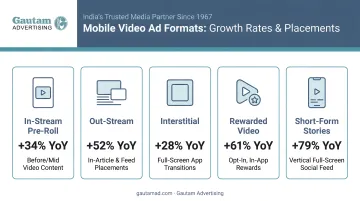
Mobile video drives some of the highest recall rates in digital advertising. Common formats include:
- In-stream ads (pre-roll, mid-roll, post-roll) that appear before, during, or after video content
- Interstitial full-screen video ads that take over the entire mobile screen
- In-feed social video ads that appear natively in social media feeds
Video combines sight, sound, and motion for high recall and engagement. Mobile video ad spend is growing at approximately 103%, nearly double the growth rate of all digital video formats combined.
Example: A 15-second pre-roll ad on YouTube promoting a new OnePlus or Realme smartphone before a tech review video plays.
Native Ads
Native ads blend seamlessly into surrounding content, matching the look and feel of the app or website. They're less disruptive and generate click-through rates of 0.38% compared to just 0.11% for banner ads—3.5x higher engagement.
Example: A sponsored article or product recommendation appearing in a news feed on platforms like Inshorts or Times of India mobile app.
Push Notifications
Push notifications are short, clickable alerts sent directly to a user's lock screen or notification tray, even when the app isn't open. They're time-sensitive and effective for promotions or re-engagement.
Example: A retail brand like Big Bazaar sending a "Flash Sale—24 hours only" notification to app users.
Click-to-Action Ads
This group includes action-oriented formats designed for immediate response:
- Click-to-call ads let users dial a business directly from the ad
- Click-to-download ads route users to the App Store or Google Play
- Click-to-message ads open an SMS or WhatsApp thread with the advertiser
These formats are particularly valuable for businesses seeking direct consumer responses—ideal for service providers, food delivery apps, and local businesses.
Key Benefits of Mobile Advertising
Key Benefits of Mobile Advertising
Mobile advertising offers capabilities that few other channels can match — from pinpoint audience targeting to real-time performance tracking. Here's what makes it a compelling option for advertisers.
Unmatched Reach and Real-Time Access
Mobile advertising reaches consumers wherever they are — commuting, shopping, or relaxing — at any time of day. With approximately 700+ million smartphone-based internet users in India, it provides access to audiences that are simply unavailable through most traditional media formats.
Precise Audience Targeting
Mobile advertising enables sophisticated segmentation:
- Demographics: Age, gender, income, occupation
- Location: Including hyper-local geofencing capabilities
- Interests and behavior: Based on app usage and browsing patterns
- Past actions: Purchase history and website visits
This precision means ad budgets reach the most relevant audience, reducing wasted spend on viewers unlikely to convert.
Cost-Effectiveness and Measurable ROI
Mobile ads typically have lower entry costs than traditional media and offer real-time performance tracking. Core metrics include:
| Metric | Definition |
|---|---|
| CTR (Click-Through Rate) | Ratio of clicks to impressions, expressed as a percentage |
| CPC (Cost Per Click) | Amount paid each time a user clicks the ad |
| CPA (Cost Per Action) | Amount paid when a user completes a specific action (purchase, sign-up, install) |
| eCPM (Effective Cost Per Mille) | Revenue earned per 1,000 ad impressions, regardless of buying method |
Ongoing A/B testing allows continuous campaign improvement based on real data.
Multiple Touchpoints in the Customer Journey
Consumers rarely convert on a single ad impression. Mobile advertising keeps brands visible across the full journey — from initial awareness through to purchase — by reaching users repeatedly across different apps, websites, and platforms. That consistent presence is often what tips a consideration into a decision.
How Mobile Advertising Is Priced
Mobile advertising costs vary widely depending on format, platform, audience, and campaign objective. There's no universal flat rate.
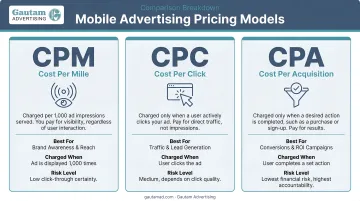
Primary Pricing Models
- CPM (Cost Per Mille): Charges per 1,000 impressions; common on social platforms for brand awareness campaigns
- CPC (Cost Per Click): Charges only when a user clicks the ad, making it ideal for driving traffic to a site or offer
- CPA/CPI (Cost Per Action/Install): Charges when a user completes a specific action — such as installing an app or completing a purchase
Format Impact on Pricing
Richer, more engaging formats like interstitial video or playable ads typically command higher CPMs but can deliver far better eCPM because their engagement rates far exceed simple banner ads. Weigh CPM against actual engagement outcomes.
India's Cost-Efficient Market
India's mobile advertising market offers exceptional cost efficiency. India's average CPM runs approximately ₹56 ($0.67), compared to ₹834–₹1,251 in the US and ₹667–₹1,000 in the UK — a gap of roughly 15–22x.
Click-based campaigns follow the same pattern: India's average CPC runs 77% below the US average, making mobile advertising highly accessible for Indian businesses at nearly any budget.
This cost advantage reflects India's high ad inventory supply (driven by 700+ million smartphone users), lower purchasing power parity, and lower advertiser density compared to Western markets.
How to Build a Mobile Advertising Strategy
Start with Clear Goals and Audience Definition
Before choosing any format or platform, define what you want to achieve:
- Brand awareness
- App installs
- Lead generation
- Direct sales
Identify precisely who you're trying to reach. These decisions dictate format choice, platform selection, and bidding strategy. Misalignment here wastes budget regardless of creative quality.
Design Mobile-First Creative
Ads must be built specifically for small screens—not adapted from desktop versions. Essential elements:
- Concise copy that delivers the message in seconds
- Strong visuals optimized for vertical viewing
- Clear CTAs that guide immediate action
- Fast-loading formats that don't frustrate users on slower connections
Poor creative is one of the most common reasons mobile campaigns underperform, regardless of targeting precision.
Integrate Mobile with Broader Media Channels
Strong creative only goes so far if it runs in isolation. The most effective mobile strategies connect with other media channels—print, digital display, and outdoor—to reinforce messaging across multiple touchpoints.
Print, for instance, builds broad brand recognition among a wide readership. Mobile then picks up that audience with targeted, trackable follow-up. Agencies with deep media relationships across both print and digital—like Gautam Advertising, which maintains access to 10,000+ publications alongside digital platforms—can help brands coordinate this kind of cross-channel planning rather than managing each channel separately. The result is compounded reach, with each medium reinforcing the other.
Frequently Asked Questions
What is mobile advertising?
Mobile advertising is paid advertising specifically designed for smartphones and tablets, appearing across apps, mobile websites, SMS, and video. Ads are tailored using user data to reach the right audience based on demographics, location, behavior, and interests.
What are the types of mobile advertising?
The main types include banner/display ads, in-app ads, video ads (pre-roll, mid-roll, interstitial), native ads that blend with content, push notifications, and click-to-action ads (click-to-call, click-to-download, click-to-message).
How effective is mobile advertising?
Mobile advertising is highly effective — Indians spend 5 hours daily on smartphones, and precise targeting with real-time measurability drives strong results. Global mobile ad spend reached $402 billion in 2024, growing 11% year-over-year.
How much does a mobile ad cost?
Costs vary based on format, platform, and audience. Common pricing models include CPM (per 1,000 impressions), CPC (per click), and CPA (per action). In India, costs are typically 15-22x lower than Western markets, with average CPMs around ₹56 ($0.67).
What is mobile-first advertising?
Mobile-first advertising means designing ads for mobile screens from the start, rather than adapting desktop creatives. Creative, layout, and messaging are built for smaller screens and on-the-go behavior — maximizing engagement and conversion rates.