Introduction
Many assume print advertising has been overtaken by digital channels—yet in India alone, newspaper readership remains among the highest worldwide, with 40.27 crore copies circulated daily across 1,48,363 registered publications. This makes print a powerful channel that still commands attention, credibility, and trust in ways digital platforms struggle to match.
This guide covers a clear definition of print advertising, the major types, concrete benefits backed by research, and the essential elements that make a print ad effective. If you work in real estate, hospitality, recruitment, education, or finance, this guide will help you understand how print media fits into a results-driven advertising plan.
Key Takeaways
- Print advertising uses physical materials—newspapers, magazines, billboards, flyers, and direct mail—to promote products, services, or brands
- It remains highly effective due to tangibility, credibility, targeted reach, and longer shelf life
- Key formats include newspaper ads, magazine ads, outdoor/billboard advertising, direct mail, and brochures
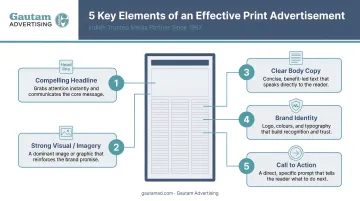
- Effective print ads need a strong headline, clear visuals, concise copy, and a direct call to action
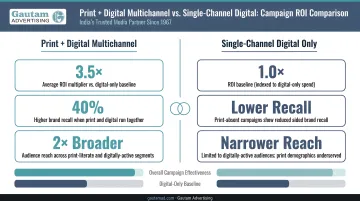
- Combined print and digital campaigns consistently outperform single-channel approaches in reach and recall
What Is Print Advertising?
Print advertising is any form of paid promotional communication delivered through physically printed media—including text, images, and design—intended to inform, persuade, or motivate a target audience to take action. Unlike broadcast (TV/radio) or digital advertising, print occupies physical space.
The history of print advertising in India traces back to January 29, 1780, when classified notices first appeared in Hickey's Bengal Gazette, the country's first newspaper. By 1838, The Bombay Times (later Times of India) began carrying classified ads. The installation of India's first rotary linotype machine at The Statesman, Calcutta, in 1907 enabled mass-circulation newspapers and catalyzed advertising growth.
Today, India's print media market remains one of the most active worldwide. According to the Registrar of Newspapers for India (RNI) 2022-23 report, daily circulation grew 2.91% year-on-year, reaching over 23 crore copies.
That growth shows up in revenue too. Print advertising revenue reached Rs 19,250 crore in 2023, with projections exceeding Rs 20,000 crore in 2024. This is particularly striking given that print accounts for just 4% of ad spend globally.
That staying power in India comes down to one defining characteristic: tangibility. Unlike a digital ad that disappears with a scroll, a newspaper ad, brochure, or poster occupies physical space, making it harder to ignore. Research confirms this tangibility drives real trust — 68.5% of consumers trust newspaper ads, according to Nielsen's 2021 Trust in Advertising Study.
What this means in practice:
- Recall: Readers engage with print more deliberately than digital, increasing message retention
- Credibility: Association with established publications lends legitimacy to the advertiser
- Shelf life: A magazine or brochure can be referenced days or weeks after publication
- Targeting: Regional and language editions allow precise geographic and demographic reach
Types of Print Advertising
Print advertising spans a wide range of media, each suited to different goals, budgets, and audiences. Here's a breakdown of the main formats and where each works best.
Newspaper Advertising
Newspaper advertising is the largest segment of print media, covering both display ads (full-page, half-page, quarter-page) and classified ads (recruitment, matrimonial, property, public notices). Advertisers can choose specific sections, editions, and regional language publications to reach precise audiences.
India's multilingual newspaper landscape allows hyper-targeted regional campaigns. According to the RNI 2022-23 report, Hindi leads with 57,050 registered publications, followed by English (20,042), Marathi (10,659), Gujarati (6,930), and seven other languages each exceeding 5,000 titles.
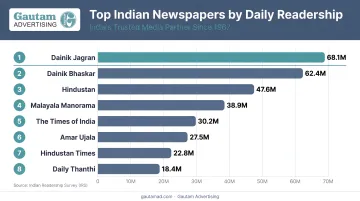
ABC data for H1 2025 shows top dailies like Dainik Bhaskar (3.04 million circulation), Dainik Jagran (2.35 million), and Times of India (1.64 million) continue to dominate readership. With this breadth of options, placement strategy—choosing the right publication, section, and edition—determines how well a campaign performs.
Magazine Advertising
Magazine ads allow brands to reach niche audiences—lifestyle, business, trade publications—with high-quality visuals on premium paper stock. The longer shelf life of magazines gives ads extended exposure; readers often keep issues for two to four weeks, compared to one day for newspapers.
A Family Circle and Citicorp study found that households exposed to magazine ads showed 22.5% higher sales, with specific brands seeing 21–25% purchase increases.
Outdoor and Billboard Advertising
Outdoor advertising covers a range of high-visibility formats:
- Hoardings and billboards along highways and key arterial roads
- Metro station posters targeting urban commuters
- Transit ads on buses, autos, and local trains
Because exposure time is brief—typically 3–5 seconds for a moving vehicle—outdoor messaging must be immediate and visually bold. This format works best for brand awareness campaigns in specific cities or corridors rather than direct-response objectives.
Direct Mail Advertising
Direct mail involves physically sending promotional material—postcards, letters, catalogs, brochures—to a targeted mailing list. The 2025 ANA/DMA Response Rate Report shows direct mail achieves a 4.4% average response rate versus email's 0.12%—a roughly 37x advantage.
Personalization (addressing a reader by name, tailoring offers) further lifts response rates. Direct mail is particularly valuable for financial, real estate, and hospitality sectors.
Flyers, Brochures, and Pamphlets
These formats differ in structure and purpose:
- Flyers: Single-sided, lowest cost, good for events and promotions
- Brochures: Folded, multi-panel, ideal for product/service overviews
- Pamphlets: Multiple pages, good for detailed information like school admissions or corporate profiles
Distribution methods include in-store placement, newspaper inserts, and direct handouts—making these formats especially practical for schools, real estate developers, and local businesses running time-sensitive campaigns.
Key Benefits of Print Advertising
Credibility and Trust
Readers associate print publications with editorial standards and fact-checking, which transfers credibility to advertisers. Nielsen's 2021 Trust in Advertising Study found that 68.5% of U.S. consumers trust newspaper ads, ranking them in the top 5 trusted channels—far above social media.
In India, the Reuters Institute Digital News Report 2025 confirmed that legacy print titles like Times of India and Hindustan Times enjoy higher trust than digital-only outlets. That trust gap is significant: 53% of Indian respondents identified WhatsApp as the channel carrying the biggest threat of false information.
Targeted Reach
Print advertising allows precise audience targeting:
- By geography: National, regional, city-level editions
- By language: Hindi, Gujarati, Marathi, Tamil, and regional options
- By section: Business, sports, entertainment, classifieds
- By publication type: Trade magazines vs. mass newspapers
In India's fragmented media landscape, this granularity is a genuine advantage — a Gujarati FMCG brand and a Mumbai-based real estate developer can each reach exactly their audience without overlapping spend.
Tangibility and Longevity
Unlike a digital ad that disappears with a click, a newspaper ad, brochure, or magazine placement stays in the physical world. A reader may clip out a property ad, keep a brochure on their desk, or refer back to a magazine ad weeks later. This extended lifespan multiplies the ad's exposure beyond its original publication date.
Deeper Reader Engagement
Print readers are less distracted than digital users. No pop-ups, notifications, or competing tabs compete for attention. Temple University's neuromarketing study using fMRI scans found that physical ads activate the hippocampus (the brain's memory center) more strongly than digital ads, producing longer-lasting memories and higher perceived value.
The results were measurable: participants correctly identified previously seen print ads at a rate of 79.5%, with stronger neural activation in areas linked to memory encoding and desirability.
Complements Digital Campaigns
Print advertising can bridge the offline-to-online gap by incorporating QR codes, custom URLs, or promo codes. The Temple University/USPS field study found that when a physical ad preceded a digital ad, click-through rates nearly doubled (2.31% vs 1.38%), and mixed-media campaigns generated 3x more applications than single-media approaches.
Analytic Partners' ROI Genome analysis, based on 700+ brands across 45+ countries, found that combining traditional and digital media delivers 25-30% higher ROI than digital executed alone. Print, in other words, makes your digital spend work harder — not by replacing it, but by warming the audience before they ever see a banner ad.
Key Elements of an Effective Print Ad
A print ad must earn attention in a crowded, static medium without motion, sound, or interactivity. Each element below carries weight — get any one wrong and the ad loses its pull.
Headline
The headline is the first—and often the only—element a reader will engage with. It must be concise, specific, and benefit-driven. Clever wordplay that obscures the message costs you readers — lead with what the audience gains, not what sounds creative. The headline should answer the reader's implicit question: "Why should I keep reading?"
Visuals and Layout
Strong imagery and white space are critical. A single dominant image outperforms cluttered designs. Visuals should directly reinforce the headline and brand message.
Technical requirements:
- Minimum resolution: 300 DPI for commercial printing
- Colour mode: CMYK (not RGB) for accurate colour reproduction
- File formats: TIFF for photos, PDF/EPS/AI for vector graphics
Colour choices should match brand identity and publication format.
Body Copy and Call to Action
Body copy does three things — no more:
- States the offer or key message upfront
- Addresses one primary audience concern
- Closes with a direct, visible CTA (e.g., "Call now," "Visit our branch," "Scan the QR code to book")
The CTA must be prominent. If a reader has to hunt for it, it won't convert.
Branding Elements
Non-negotiables include:
- Logo
- Brand colours
- Contact information (phone, website, address)
- Trust signals (awards, certifications, years in business)
Readers exposed to the same visual identity across multiple publications are far more likely to recall and trust the brand when it matters — at the point of decision.
Print Advertising in India: Why It Still Matters
India's print media market stands apart globally — driven by a large and growing literate population, dozens of active regional language newspapers, and deep reader trust in established publications.
India's newspaper circulation grew 2.91% year-on-year, reaching 23.22 crore daily copies in 2022-23. Print ad revenue reached ₹ 19,250 crore in 2023, with projections exceeding ₹ 20,000 crore in 2024. Print commands approximately 20% of India's total domestic ad spend—versus roughly 4% globally.
That disproportionate share reflects how deeply print is embedded in Indian commercial life. Across sectors, businesses consistently turn to newspapers to reach audiences that digital channels miss:
- Real estate developers run display ads for project launches in local dailies
- Banks and financial institutions publish statutory notices and product campaigns
- Schools advertise admissions in regional papers where parents actively look
- Recruitment firms fill roles through classified sections in city editions
- Matrimonial advertisers rely on Gujarati and Hindi publications for community reach
Navigating this fragmented landscape — choosing the right publication, edition, section, language, and ad size — takes experience. Gautam Advertising, INS-accredited since 1976 and with 50,000+ advertisers served, helps businesses identify the right placements and secure competitive rates across India's print ecosystem.
Frequently Asked Questions
Frequently Asked Questions
What are the benefits of print advertising?
Print advertising offers high reader trust, targeted reach by geography and language, tangibility that extends ad lifespan, deeper engagement with fewer distractions, and the ability to complement digital campaigns for stronger overall results.
Who is the target audience for newspapers?
Newspaper audiences span educated adults across age groups, with strong readership among professionals, business owners, and decision-makers. Regional language papers further segment audiences by language, geography, and community ties.
What are the main types of print media?
The primary types are newspapers, magazines, outdoor/billboard advertising, direct mail, and brochures/flyers/pamphlets. Each serves different objectives, from mass awareness to niche targeting.
What is print media advertising and what are some examples?
Print media advertising is promotional content delivered through physical printed channels. Examples include a full-page newspaper ad for a property launch, a recruitment classified in a regional daily, a brochure for a hospitality brand, or a highway billboard.
What are the key elements of a print ad?
Every effective print ad has five essentials: a strong headline, compelling visuals, concise benefit-focused body copy, a clear call to action, and consistent branding with contact details.
What are the expectations of effective print advertising copy?
Effective print copy is clear, benefit-driven, and written in plain language your target reader understands. It keeps the layout clean and ends with a specific call to action that drives action.