This is Digital Out-of-Home (DOOH) advertising — and it's rapidly becoming one of the most powerful advertising channels for brands in India and globally. With global DOOH expenditure reaching $17.9 billion in 2024 and India's DOOH market growing at nearly 14% CAGR, brands can no longer ignore this medium. This article will clearly define DOOH advertising, explain how it differs from traditional OOH, and show why it's transforming the way brands reach audiences.
Key Takeaways
- DOOH stands for Digital Out-of-Home advertising — ads delivered via digital screens in high-traffic public spaces like malls, airports, metro stations, and highways.
- Unlike static billboards, DOOH displays dynamic content updated remotely, in real time.
- DOOH offers superior targeting, flexibility, and measurability versus traditional OOH.
- It integrates with mobile and social channels to strengthen omnichannel campaigns.
- India's DOOH market is projected to grow from USD 282.6 million in 2024 to USD 630 million by 2030.
What is DOOH Advertising?
Digital Out-of-Home (DOOH) advertising refers to paid advertising content delivered through digital screens placed in shared, public environments outside the home. These include LED billboards on highways, digital displays in shopping malls, screens in metro stations and airports, and in-store digital signage.
How DOOH Works
DOOH operates through networked digital screens connected to centralized content management systems. Advertisers remotely upload, schedule, and manage ad content — including static images, videos, animations, live data feeds, and interactive elements — without physical intervention. This network connectivity enables real-time updates, allowing brands to adjust messaging instantly based on factors like weather, time of day, or local events.
DOOH vs. Digital Signage: What's the Difference?
Digital signage refers to the underlying screen technology and infrastructure — the hardware and software that powers the displays. DOOH is the advertising channel that uses those screens to deliver paid campaigns to target audiences. Digital signage is the tool; DOOH is the media strategy built on top of it.
The Rise of Programmatic DOOH (pDOOH)
Programmatic DOOH (pDOOH) enables automated, data-driven buying and selling of DOOH inventory in real time. Like programmatic digital advertising, pDOOH allows advertisers to serve dynamic, contextually relevant content based on triggers such as weather conditions, traffic patterns, demographics, or proximity to points of interest. Global pDOOH spend reached $1.7 billion in 2024, accounting for 9.4% of total DOOH revenues, and is forecast to grow to $2.2 billion in 2025.
DOOH in the Indian Context
India is one of the fastest-growing DOOH markets in Asia-Pacific — and for Indian consumers, it's already part of everyday life:
- Digital screens in Mumbai Metro stations during the morning commute
- Large LED billboards along the Mumbai-Pune Expressway
- Digital displays in premium malls like Phoenix or Palladium
- Screens at international airports in Delhi and Mumbai
- In-store digital panels in retail outlets and supermarkets
Each of these placements captures attention at a specific moment — commuting, shopping, travelling — which is exactly what makes DOOH effective as a media channel.
DOOH vs. Traditional OOH: Key Differences
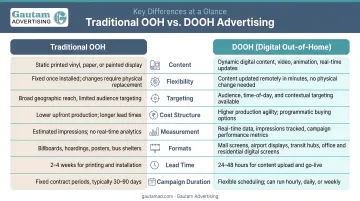
Traditional Out-of-Home (OOH) advertising includes static printed formats like flex hoardings, bus shelter posters, gantry boards, and transit ads. These formats display fixed creative for the entire campaign duration, with no ability to change content remotely.
Core Distinction: Static vs. Dynamic
What separates DOOH from traditional OOH comes down to control — who can change the ad, how fast, and based on what triggers:
| Factor | Traditional OOH | DOOH |
|---|---|---|
| Content Type | Static printed images | Dynamic videos, animations, live data |
| Update Method | Physical replacement of printed material | Remote digital updates in real time |
| Flexibility | Fixed for campaign duration | Adjustable by daypart, weather, or audience |
| Targeting | Broad, location-based only | Data-driven, contextual, and audience-specific |
| Measurement | Estimated footfall and impressions | More precise tracking with attribution |
Measurement as a Key Differentiator
Traditional OOH relies on estimated audience figures based on location footfall and traffic counts. DOOH enables more accurate tracking of impressions, dwell time, reach, and brand lift — and can integrate with mobile data for post-exposure attribution.
Traditional OOH relies on estimated audience figures based on location footfall and traffic counts. DOOH enables more accurate tracking of impressions, dwell time, reach, and brand lift — and can integrate with mobile data for post-exposure attribution.
That measurement advantage matters more than most advertisers expect. According to a 2023 benchmark report by Solomon Partners commissioned by the OAAA, OOH advertising as a category produces the highest consumer ad recall of any media channel — 86% peak recall, versus 72% for streaming and 60% for linear TV. DOOH takes that recall strength further by adding the measurability to prove it.
Cost and Use Case Trade-offs
Traditional OOH typically offers lower CPMs (cost per thousand impressions) and works well for sustained brand awareness with constant 24/7 visibility. DOOH costs more due to infrastructure investment but delivers greater flexibility, precise targeting, and interactivity. For Indian advertisers weighing both, high-footfall DOOH locations — airport terminals, metro stations, or premium mall atriums — often justify the premium when campaign timing and audience precision are priorities.
Types of DOOH Formats and Environments
Large-Format Digital Billboards and Spectaculars
Large-format LED billboards along highways, digital displays on building facades, and screens in urban centres dominate the DOOH landscape. These high-visibility formats are ideal for brand launches, broad awareness campaigns, and achieving mass reach. In India, expressway LED hoardings in Mumbai, Delhi, and Bengaluru serve as prime examples, capturing attention of commuters and travellers at scale.
Transit and Travel DOOH
Where billboards target audiences in motion, transit environments hold them in place. Screens in airports, metro stations, bus terminals, railway platforms, and inside transit vehicles offer repeat exposure and captive dwell time.
These environments are particularly effective for:
- Travel-related brands (airlines, hotels, car rentals)
- FMCG products targeting daily commuters
- Financial services reaching business travellers
India's expanding metro networks — including Mumbai Metro and Bengaluru Metro — provide growing DOOH inventory in these high-dwell environments.
Place-Based DOOH Screens
Place-based DOOH refers to screens inside specific venues:
- Shopping malls
- Gyms and fitness centres
- Office buildings
- Hospitals and clinics
- Hotels and restaurants
- Entertainment venues
Contextual relevance is what sets this format apart. A fitness brand on a gym screen or a hotel chain ad at an airport departure lounge reaches audiences whose mindset already aligns with what's being advertised.
Retail and Point-of-Purchase DOOH
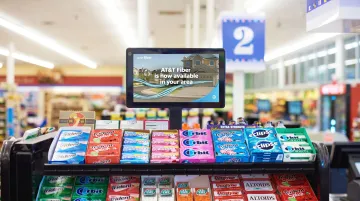
In-store digital screens — checkout counters, aisle displays, shelf-level screens, digital menu boards — reach shoppers exactly when purchase intent peaks. The numbers reflect this: 82% of all shopping decisions are made in-store, and 72% of shoppers make unplanned purchases based on in-store messaging. For brands focused on immediate sales and product trial, retail DOOH is difficult to match.
Key Benefits of DOOH Advertising
High-Impact Visibility and Consumer Favourability
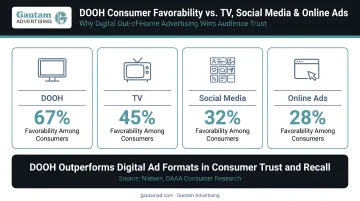
DOOH ads appear in public environments with no ad blockers, skip buttons, or bot traffic to contend with. 73% of consumers view DOOH ads favourably — well ahead of television (50%), social media (48%), and online ads (37%). And 85% of adults look at OOH ads all, most, or some of the time.
Dynamic Content and Precise Targeting Capabilities
DOOH allows advertisers to:
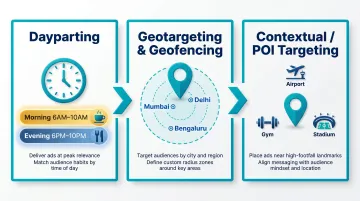
- Daypart scheduling — serve breakfast ads during morning commute hours and dinner promotions in the evening
- Geotargeting — limit ad delivery to screens within specific cities, neighbourhoods, or radii
- Contextual/POI targeting — select screens near events, competitors, or places relevant to the brand
- Weather-triggered ads — display umbrella ads on rainy days or cold beverage ads during heat waves
For example, a restaurant brand can show breakfast menu ads from 7–10 AM, lunch specials from 12–2 PM, and dinner promotions from 6–9 PM — all without relying on personal identifiers, making DOOH privacy-safe.
Measurable Results and Omnichannel Amplification
DOOH campaigns can be measured through impressions, reach estimates, brand lift studies, and footfall attribution. 76% of recent DOOH ad viewers took action after seeing an ad, with 44% searching online and 38% visiting the advertiser's website. DOOH also connects directly with mobile retargeting, social media, and CTV campaigns, reinforcing brand messages across physical and digital touchpoints in a single, coordinated push.
How DOOH Targeting and Campaigns Work
Three Primary Targeting Methods
DOOH campaigns don't broadcast blindly — they reach the right audience at the right place and time through three core targeting approaches.
Dayparting: Serving ads during specific times when target audiences are most receptive. A coffee brand might advertise during morning commute hours (7–10 AM), while a restaurant promotes happy hour specials from 5–7 PM.
Geotargeting and Geofencing: Limiting ad delivery to screens within specific geographic areas. A local retailer can target screens within a 5 km radius, or a national brand can focus on tier-1 cities like Mumbai, Delhi, and Bengaluru.
Contextual/POI Targeting: Selecting screens near events, competitors, or places of interest. A hotel chain might target screens at airports and business districts, while a sports brand advertises near gyms and stadiums.
These methods work best when combined. Here's how they come together in a real campaign.
Practical Example: A DOOH Campaign in Action
Consider a hotel chain running a DOOH campaign targeting business travellers:
- Objective: Drive direct bookings and brand awareness among frequent business travellers
- Screen Selection: Digital displays in airport lounges, metro stations near business districts, and premium malls
- Timing: Ads run during peak travel hours (6-9 AM and 5-8 PM)
- Creative: Dynamic content showcasing business-friendly amenities, meeting facilities, and special corporate rates
- Mobile Retargeting: Audiences who pass by the DOOH screens are retargeted on their mobile devices with personalised booking offers
- Measurable Outcomes: Brand recall increases by 30%, website visits rise by 25%, and direct bookings attributed to DOOH exposure grow by 18%
Key DOOH Campaign Metrics to Track
- Impressions delivered: total number of times the ad was displayed
- Estimated reach: unique individuals exposed to the campaign
- Dwell time: average time audiences spend viewing the screen
- Brand lift: measured through surveys comparing exposed vs. control groups
- Footfall attribution: physical visits to stores or venues linked to DOOH exposure
Integrating DOOH into Your Advertising Strategy
How DOOH Complements a Broader Media Mix
DOOH works best as part of a multi-channel strategy alongside print, digital, and broadcast advertising. DOOH builds awareness in the physical world, while digital channels handle retargeting, conversion, and engagement. Together, they create a full-funnel campaign that reaches consumers at multiple touchpoints — from initial awareness to final purchase.
Practical Guidance for Indian Advertisers
When evaluating DOOH for your brand, consider:
- Campaign objective — Are you focused on awareness, consideration, or conversion?
- Target audience locations — Where do your customers spend time during their daily routines?
- Budget allocation — How much can you dedicate to DOOH versus other channels?
- DOOH environment fit — Do transit screens, retail displays, or large-format billboards best align with your audience?
India's expanding DOOH inventory in tier-1 cities like Mumbai, Delhi, and Bengaluru — and growing presence in tier-2 cities — gives brands more touchpoints to reach consumers across income levels, geographies, and daily routines.
Navigating DOOH with Expert Guidance
Choosing the right mix of print, traditional OOH, and DOOH placements requires both media knowledge and established publisher relationships. Gautam Advertising has spent 55+ years building those relationships — working with 10,000+ publications and digital media partners across India.
Whether you're planning a national campaign or targeting a specific city, that depth of access translates to better placement decisions, negotiated rates, and a media plan built around your actual objectives.
Get in touch with Gautam Advertising to explore how DOOH and integrated media strategies can elevate your brand's reach and results.
Frequently Asked Questions
What does DOOH mean in media?
DOOH stands for Digital Out-of-Home advertising — ad content delivered through digital screens in public spaces such as airports, malls, metro stations, and highways. It combines dynamic digital displays with data-driven targeting to reach audiences in high-traffic environments.
What is the difference between DOOH and OOH advertising?
OOH uses static printed formats like vinyl billboards and bus shelter posters, while DOOH uses digital screens with dynamic, remotely updated content. DOOH offers greater flexibility, data-driven targeting, and more precise measurement compared to traditional OOH.
How does digital DOOH advertising work?
DOOH screens are connected to a network, enabling advertisers to remotely schedule and update content. Programmatic DOOH uses automated bidding and data signals — time, location, weather — to serve the right ad on the right screen at the right time, maximising relevance and impact.
What is a DOOH campaign?
A DOOH campaign is a planned advertising effort using digital out-of-home screens to reach a target audience. It's structured around:
- Screen locations and timing (dayparting)
- Audience targeting parameters
- Creative content
- Measurable goals such as brand awareness, foot traffic, or direct response
What is an example of a DOOH ad?
Common examples include a digital billboard on a highway promoting a car brand, a screen inside an airport lounge displaying a hotel's special offer, or a retail store display showing a product promotion near the checkout counter.
How much does DOOH advertising cost?
DOOH costs in India vary by screen format, location, audience reach, and campaign duration. A static billboard typically costs around ₹20 lakh, while DOOH slots start from approximately ₹5 lakh — shared across multiple advertisers in rotation, making it a cost-efficient entry point. For context, US CPM benchmarks for digital place-based media run $7–$34, well below broadcast TV's $45–$49 CPM.