Introduction
Streaming has officially overtaken traditional television. In India, the shift is stark: the country's streaming audience has surged to 601.2 million users (over 40% of the population), while cable TV subscriptions have halved to approximately 60 million and DTH subscribers declined by 12.4% year-on-year. Globally, the trend is identical — Nielsen's The Gauge reports streaming captured 47.5% of all US TV viewing in December 2025, more than double broadcast (21.4%) or cable (20.2%) combined.
For advertisers, this is a fundamental restructuring of the media landscape. Those audiences have migrated to streaming platforms, and reaching them now requires a different approach.
This guide covers everything advertisers need to know about OTT advertising: what it is, how it works, the formats available, the costs involved, and the best practices that drive results. Whether you're a challenger brand exploring digital video for the first time or an established advertiser looking to reach audiences who have moved to streaming, this guide gives you a practical starting point.
Key Takeaways
- OTT advertising delivers video ads via internet streaming platforms like Netflix, JioHotstar, Prime Video, and MX Player — bypassing cable or satellite TV
- Targets audiences by household, behavior, interest, and location — with real-time measurement traditional TV cannot match
- Delivers 95.8% video completion rates on CTV devices and drives 25% brand awareness lift versus 9% for standard digital ads
- CPMs range from ₹800–₹3,500, varying by platform, audience specificity, and inventory quality
What Is OTT Advertising?
OTT (over-the-top) refers to the delivery of video content directly to viewers via the internet, bypassing cable, satellite, or broadcast infrastructure. OTT advertising is the placement of promotional video content within these streaming environments — whether on Netflix, Amazon Prime Video, JioHotstar, MX Player, or any of the hundreds of ad-supported platforms now competing for viewer attention.
The term "over-the-top" literally means the content goes "over" traditional distribution networks, delivered through broadband connections to any internet-enabled device. For advertisers, this means audiences are no longer tied to a TV set, a cable subscription, or a fixed schedule. They watch what they want, when they want, on the device of their choice — and ad spend must follow.
The cord-cutting trend driving OTT growth is accelerating globally and in India. In the US, eMarketer projected that by 2024, cord-cutters and cord-nevers (138.1 million) would outnumber pay-TV subscribers (129.3 million), with the gap widening each year. India's numbers tell a similar story: DTH subscribers fell from 58.22 million (December 2024) to 50.99 million (December 2025) — a loss of over 7 million subscribers in just 12 months. Cable TV subscriptions have halved to approximately 60 million, while connected TV homes reached 30 million and are growing at 87% year-on-year.
India's OTT platforms are capturing scale that traditional TV never could:
- JioHotstar's IPL 2025 Final recorded 892 million video views and a peak concurrency of 55 million viewers — the highest ever for a cricket match
- MX Player attracted 99 million unique visitors in December 2024, making it India's largest free streaming service
- ZEE5 and SonyLIV continue expanding content libraries and subscriber bases
- Prime Video and Netflix have both launched ad-supported tiers specifically to capture advertiser demand in India
OTT vs. CTV: What's the Difference?
OTT refers to how content is delivered — over the internet. CTV (Connected TV) refers to the device used to access it — internet-connected televisions, streaming sticks (Roku, Amazon Fire TV), smart TV apps, and gaming consoles.
All CTV is OTT, but not all OTT is CTV. OTT ads can appear on smartphones, tablets, laptops, and desktops in addition to TV screens. CTV ads specifically appear on the big screen in the living room.
This distinction matters for campaign planning. CTV accounts for approximately 77% of streaming viewing time globally, with mobile at 11%, desktop at 7%, and tablets at 5%. In India, traditionally a mobile-first market, the shift toward big-screen viewing is accelerating rapidly. CTV users surged 87% year-on-year to 129.2 million in 2025, reflecting a migration from mobile to living-room screens. Advertisers must optimise creative for multiple devices, but CTV represents the largest share of attention and delivers the highest completion rates.
Understanding VOD Models
Not all streaming platforms operate the same business model — and each model creates different advertising opportunities:
AVOD (Ad-Supported Video on Demand): Free streaming services fully funded by advertising. Examples include MX Player (India's largest), JioCinema free tier, Tubi, and Pluto TV. AVOD platforms offer the highest volume of ad inventory at the most accessible price points.
SVOD (Subscription Video on Demand): Paid subscription services that now offer ad-supported tiers. Netflix, Disney+, Prime Video, and HBO Max have all launched lower-cost ad-supported plans. 71% of all net new streaming subscribers over the past nine quarters chose ad-supported plans, and Netflix ad-tier adoption grew from 26% to 40% in under a year.
TVOD (Transactional Video on Demand): Pay-per-view or rental models (for example, iTunes rentals). Limited advertising inventory.
FAST (Free Ad-Supported Streaming TV): Linear-style channels delivered over the internet with ad breaks, mimicking traditional TV but fully digital. Nearly 1,870 FAST channels operate globally, with viewing hours reaching 1.8 billion in August 2025 — a 43% year-on-year increase.
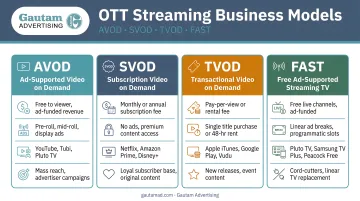
AVOD and SVOD ad-supported tiers are where advertiser budgets are shifting fastest — they combine mass reach with the audience targeting precision that traditional TV never offered.
How OTT Advertising Works
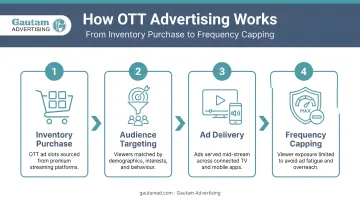
OTT advertising operates through a distinct infrastructure than traditional TV. Here's how an ad moves from planning to viewer screen:
Step 1: Inventory Purchase Advertisers buy OTT ad inventory through two primary channels:
- Direct Insertion Orders (IOs): Negotiated placements with fixed CPMs, guaranteed impressions, and specific content alignment. Used for premium placements on platforms like Netflix or JioHotstar.
- Programmatic Buying: Real-time bidding through a Demand-Side Platform (DSP), where advertisers bid on impressions as they become available. 75% of CTV ad transactions are now executed programmatically, allowing advertisers to adjust targeting, bids, and pacing in real time across multiple platforms.
Step 2: Ad Serving Once inventory is secured, ads are delivered using one of two methods:
- Client-Side Ad Insertion (CSAI): The viewer's device pauses the content stream, fetches the ad from a separate ad server, plays it, then resumes content. Because the ad request comes from an identifiable URL, CSAI is vulnerable to ad blockers.
- Server-Side Ad Insertion (SSAI): The ad is "stitched" directly into the video stream on the server before it reaches the viewer's device, arriving as one seamless stream. Standard ad blockers cannot detect or block SSAI ads, resulting in higher fill rates and a buffer-free experience.
Step 3: Audience Targeting OTT's targeting capabilities far exceed traditional TV's broad demographic reach. Advertisers can layer multiple data sets to reach specific households or viewer profiles:
- First-party CRM data: Upload customer email lists or phone numbers for household-level targeting
- Third-party demographic and behavioral segments: Target by age, income, interests, purchase behavior, and life stage
- Contextual signals: Align ads with content genre (sports, drama, news) or viewing environment (time of day, device type)
- Geographic targeting: Reach audiences by country, state, city, or pincode
Step 4: Frequency Capping and Ad Pod Management OTT platforms control viewer experience through:
- Frequency capping: Caps exposure per household — typically 2-3 impressions per week, with a campaign ceiling of 8-10 impressions to prevent fatigue.
- Ad pods: OTT breaks run 1-4 ads versus 8-12 on linear TV — less clutter means higher ad recall and less viewer drop-off.
Types of OTT Ad Formats
OTT advertising offers multiple creative formats designed for different campaign objectives and viewer contexts:
In-Stream Video Ads
These are the core video ad formats appearing before, during, or after content:
- Pre-roll: Ads that play before content begins. High visibility but can feel intrusive if viewers are eager to start watching.
- Mid-roll: Ads inserted during natural content breaks (typically during longer-form content like movies or hour-long episodes). Non-skippable mid-roll ads on premium platforms achieve 95.8% completion rates on CTV devices — 15 percentage points higher than mobile (80.7%) or desktop (81.7%).
- Post-roll: Ads that play after content ends. Lower completion rates as viewers often navigate away immediately.
Ad length also shapes performance. 30-second ads hold completion rates above 92%, but anything beyond 45 seconds drops to 66-68%. For performance campaigns focused on site visits or conversions, 15-second ads at higher frequency reduce fatigue while keeping your message in front of viewers — a format well-suited to India's fast-growing OTT platforms like JioCinema, Hotstar, and SonyLIV.
Interactive and Shoppable Ads
Interactive CTV ads achieve engagement rates 10x higher than standard video formats. Options include:
- QR codes: Displayed on-screen for viewers to scan with their mobile devices, driving immediate website visits or app downloads. 33% of consumers report scanning QR codes on their TV if they lead to a familiar site.
- Clickable overlays: Remote-click functionality allowing viewers to "add to cart," request more information, or navigate to a landing page without leaving the streaming app.
- Product carousels: Scrollable on-screen product galleries integrated into the ad experience.
Amazon measured a 12% purchase-rate uplift when brands combined pause ads (see below) with standard video spots — meaning the 12% gain came directly from adding a second format, not from increasing budget or frequency.
Pause Ads
When a viewer pauses content, a static or animated ad appears on-screen. Originally introduced as small, non-intrusive overlays, pause ads have evolved into full-screen formats across major streamers:
- Netflix: 77% of ad-tier members keep pause ads visible for 15+ seconds; some formats are scene-matched to the paused content for contextual relevance.
- Amazon Prime Video: Full-screen interactive pause ads with remote-click "add to cart" functionality.
- Disney/Hulu: "Pause+" format that starts small and expands to full-screen on viewer opt-in; includes trivia or coupons.
Pause ads work differently from standard interruptions: viewers trigger the ad themselves by pausing, which typically means higher-quality attention than a forced pre-roll.
Companion and Banner Ads
These formats appear alongside or outside the video player:
- Companion ads: Static or animated banners displayed next to the video player on desktop or tablet screens.
- Home screen placements: Ads on the streaming platform's main menu or content selection screen, building brand awareness before content even starts.
Both formats work best as supplements to video campaigns — reinforcing brand recall at low incremental cost rather than carrying the campaign on their own.
Key Benefits of OTT Advertising
Precision Targeting and Audience Relevance
Traditional TV targets broad demographics: "adults 25-54" or "women 18-49." OTT enables granular targeting by household, behavior, interest, location (down to PIN code), and device. The result: CTV viewers are more likely to recall and respond to relevant ads.
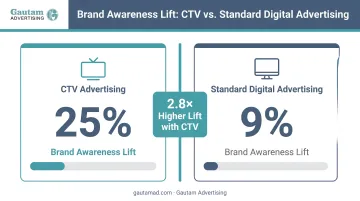
CTV delivers a 25% lift in brand awareness and ad recall, compared to 9% for standard digital advertising — a 2.5x advantage. When a CTV ad runs before a digital ad, unaided brand recall increases by 125% and purchase intent rises by 18% versus digital ads alone.
Incremental Reach Among Cord-Cutters
India's 601.2 million streaming audience includes tens of millions of households that have abandoned cable and DTH entirely. With DTH subscribers declining to 50.99 million and cable to approximately 60 million, OTT is the only way to reach this growing segment.
Across age groups, streaming audiences skew younger and more affluent — exactly the segment most likely to switch brands and make high-value purchases. Advertisers relying solely on traditional TV are missing this cohort entirely.
Real-Time Performance Measurement and Optimization
Traditional TV relies on panel-based estimates (GRPs, TRPs) that provide directional reach without household-level granularity. OTT provides impression-level tracking, household attribution, and conversion measurement:
- Impressions delivered: Total ad views
- Completion rate: Percentage of viewers who watched the ad to completion
- Viewability: Percentage of ads that met viewability standards
- Site visits post-exposure: Website traffic attributed to OTT ad exposure
- Conversions and ROAS: Direct attribution of sales or leads to OTT campaigns
A VAB study of 201 first-time TV advertisers found an average 12% website-traffic increase in the first month on air, with 20% sustained monthly increases throughout the campaign. This level of attribution is impossible with linear TV.
Full-Funnel Capability
That measurability is what makes OTT viable beyond awareness. When integrated with retargeting and cross-device strategies, OTT drives consideration, website visits, and direct conversions. Integrated TV+Digital campaigns deliver 200% higher conversions than TV-only campaigns — making OTT one of the few video channels where every rupee spent can be traced to an outcome.
OTT Advertising Costs and Measurement
What Influences OTT Advertising Costs?
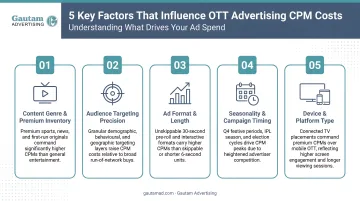
OTT advertising costs vary based on five key factors:
- Targeting precision: Narrow audience segments (e.g., "Mumbai households, age 30-45, interested in luxury goods") command higher CPMs but eliminate waste.
- Platform and inventory quality: Premium platforms like Netflix or Disney+ command higher rates (₹2,000–₹3,500 CPM) than free AVOD platforms like MX Player or Tubi (₹800–₹1,500 CPM).
- Ad format: Interactive and pause ads typically cost more than standard pre-roll or mid-roll.
- Campaign duration and volume: Longer campaigns and higher impression volumes can unlock volume discounts.
- Programmatic vs. direct buying: Programmatic introduces dynamic pricing that adjusts based on real-time demand; direct IOs lock in fixed rates.
Typical OTT CPM Ranges
US Market (for reference):
| Platform | CPM Range (USD) |
|---|---|
| Netflix | $25–$45 |
| Disney+ | $25–$40 |
| Prime Video | $20–$35 |
| Hulu | $20–$30 |
| Free AVOD/FAST | $10–$20 |
India Market: CTV ad spending in India tripled from INR 450 crore (2022) to INR 1,500 crore (2024), with projections reaching INR 2,300–2,500 crore by end of 2025. Indicative CPM ranges run ₹800–₹3,500 depending on platform tier and targeting precision, with exact rates varying by campaign scale and negotiated terms.
Minimum Spend Entry Points
| Channel | Minimum Spend |
|---|---|
| Aggregated platforms | ₹4,000–₹8,000 |
| Programmatic DSPs | ₹4,00,000–₹8,00,000 |
| Direct placements (agency) | ₹8,00,000+ |
| Direct Netflix | ₹4,00,00,000+ (estimated) |
OTT Measurement vs. Traditional TV
Understanding costs is only part of the picture — how you measure results matters just as much. OTT and traditional TV take fundamentally different approaches:
| Metric | Traditional TV | OTT |
|---|---|---|
| Measurement method | Panel-based (GRPs, TRPs) | Impression-level, household-level |
| Attribution | Post-campaign estimates | Real-time conversion tracking |
| Granularity | Approximate reach/frequency | Completion rates, site visits |
| Household detail | Limited | Full (where available) |
India's CTV measurement ecosystem still has ground to cover: only 50% of CTV impressions globally offered full app transparency in 2024, and approximately 7–8% of CTV ad spend in India delivers no working value due to invalid traffic, unviewable placements, or unmeasurable impressions.
Advertisers should demand log-level data and third-party verification before committing budgets.
OTT Advertising Best Practices
Lead with Audience-First Strategy
Define your target viewer using first-party data, lookalike modeling, and behavioral segments before buying any inventory. Pair precision targeting with contextual placement to maximize relevance:
- Align fitness brand ads with health and wellness content
- Place travel ads within adventure or documentary programming
- Match financial services ads to business news or economic content
Audience segments should have a minimum floor of 200,000–300,000 households for reliable delivery and measurement — a benchmark that applies primarily to larger OTT markets; Indian advertisers should confirm thresholds with their platform or media partner.
Optimize Creative for the Streaming Environment
OTT viewers expect fewer, shorter ad breaks than linear TV. Follow these creative guidelines:
- Keep ads concise: 15–30 seconds is optimal. Completion rates drop sharply beyond 30 seconds.
- Hook within 3 seconds: Attention drops quickly; lead with your strongest visual or message.
- Format for multiple devices: Ensure your creative works full-screen on TV, in mobile vertical and horizontal orientations, and on tablets.
- Include clear CTAs: Whether driving site visits, app downloads, or brand recall, state the desired action explicitly.
Integrate OTT into a Broader Media Mix
OTT works best as part of a multi-channel strategy. Running CTV ads before digital ads increases unaided brand recall by 125% and purchase intent by 18%. Coordinating OTT exposure with print, digital display, and social campaigns amplifies recall and drives higher overall ROI.
This cross-channel coordination is where agency expertise matters most. Gautam Advertising, with over 55 years of media planning experience and 100+ media partnerships across print, digital, and out-of-home channels, helps Indian advertisers fit OTT into a cohesive, budget-efficient media strategy.
Frequently Asked Questions
How does OTT advertising work?
OTT ads are delivered within internet-streamed video content via programmatic or direct buying, targeting specific audience segments using behavioural and demographic data. Ads are served either client-side or server-side and can be measured in real time against performance metrics like completion rate and site visits.
What is the difference between OTT and CTV ads?
OTT refers to the delivery method — streaming over the internet. CTV refers to the device — internet-connected television screens. OTT ads can appear across smart TVs, mobile, tablets, and desktops, while CTV ads specifically appear on connected TV screens in the living room.
What are the benefits of OTT advertising?
OTT enables precision targeting by household, behaviour, and location — reaching cord-cutter audiences that traditional TV simply cannot. Campaigns are measurable in real time and can drive results across the full funnel, from brand awareness through to conversions.
What is the cost of OTT advertising?
OTT ad costs depend on targeting precision, platform quality, ad format, and campaign duration. Costs are typically priced on a CPM basis, with Indian OTT CPMs ranging from ₹800–₹3,500 depending on platform tier. Programmatic buying offers more flexibility than fixed direct placements.
How to advertise on OTT?
Start by defining your campaign goals and identifying your target audience. Produce a 15–30 second video creative compatible across devices, choose your platform and buying method (programmatic DSP or direct IO), then launch and optimise using real-time performance data.
What is an example of OTT?
Popular OTT platforms globally include Netflix, Amazon Prime Video, Hulu, and Disney+. In India, major platforms include JioHotstar, ZEE5, SonyLIV, and MX Player. An OTT ad example would be a non-skippable 30-second pre-roll ad appearing before a web series episode on any of these platforms.