
Introduction
Digital advertising now commands 60% of India's total advertising market, reaching ₹1,64,137 crore in 2025 according to GroupM's TYNY report. With over 1 billion Indians now online—representing 70% internet penetration—businesses can no longer treat website advertising as optional. The addressable digital audience has never been larger, spanning metros to Tier 2 and 3 cities alike.
Yet many business owners still question whether online ads deliver measurable returns or simply drain marketing budgets. The hesitation is understandable: the jargon is dense, and the platforms constantly evolve.
The numbers, however, are hard to argue with. Global digital ad spending reached $740.3 billion in 2024, growing 8.9% year-over-year—because advertisers across the world are seeing results they can track and scale.
This article lays out the concrete advantages of website advertising, what businesses lose by sitting it out, and the best practices that separate campaigns that convert from ones that burn budget.
Key Takeaways
- Website advertising delivers broad, measurable reach to audiences actively researching and buying online
- Precise targeting cuts wasted impressions by reaching high-intent prospects rather than broad, unqualified audiences
- Real-time measurability enables continuous optimization and transparent ROI tracking
- Flexible budgets make digital campaigns accessible to startups and corporates alike
- Success depends on ongoing data review and integration with other channels — not one-time campaign setup
What Is Website Advertising?
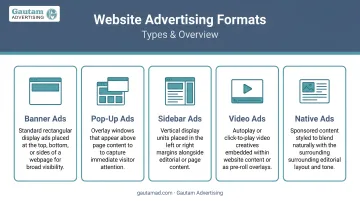
Website advertising is paid promotional content placed across digital platforms—search engines, social media, display networks, publisher websites—to drive specific business outcomes like awareness, traffic, leads, or sales.
Common formats include:
- Google Search ads that appear above organic results when users search relevant keywords
- Display banner ads served across thousands of publisher websites through programmatic networks
- Social media sponsored posts on platforms like Meta (Facebook/Instagram), LinkedIn, and Twitter
- Video pre-rolls on YouTube, OTT platforms, and streaming services
- Programmatic placements that use automated bidding to serve ads in real time based on user behaviour
Website advertising is a direct response mechanism. You pay to place your message in front of a defined audience and measure every resulting action—whether that's a click, form submission, purchase, or phone call.
Key Advantages of Website Advertising
The advantages below are operational and measurable—not abstract marketing theory. Each directly impacts KPIs that businesses track weekly.
Advantage 1: Precise Audience Targeting
Website advertising allows businesses to define exactly who sees their ads: demographics, location, interests, online behavior, and purchase intent. This specificity is unavailable in traditional media like print or outdoor advertising, where impressions are estimated and audiences are broad.
How targeting works in practice:
Platforms like Google Ads and Meta use first-party data and behavioral signals to serve ads to users who closely match your ideal customer profile. Two examples show the range of precision available:
- A Mumbai-based real estate developer can target users aged 30–45, earning above ₹12 lakh annually, who have recently searched for "2 BHK apartments in Andheri" or visited property listing sites
- A B2B software company can target CFOs at companies with 50+ employees in the BFSI sector who have engaged with financial compliance content
What the data shows:
Google's Responsive Search Ads deliver 5–15% higher click-through rates compared to static ads by dynamically combining up to 15 headlines and 4 descriptions based on user context. Meta's Advantage+ AI targeting delivers 13% lower cost per catalog sale and 28% lower cost per click versus manual targeting.
KPIs impacted:
- Cost per click (CPC) decreases when ads reach high-relevance audiences
- Click-through rate (CTR) improves as messaging aligns with user intent
- Conversion rate rises when targeting filters for qualified prospects
- Cost per acquisition (CPA) drops as the proportion of converting clicks increases
Advantage 2: Real-Time Measurability and Campaign Control
Unlike print or outdoor advertising—where results are estimated—every website advertising campaign generates detailed performance data: impressions, clicks, time-on-site, conversions, and customer journey touchpoints. You see exactly which ads drove action, which keywords delivered leads, and which audiences converted.
How real-time dashboards work:
Platforms like Google Ads and Meta Ads Manager provide live performance data. Mid-campaign adjustments are immediate:
- Pause an ad set generating clicks but no conversions by day three, then reallocate budget to top performers
- Adjust bids or exclude a keyword if its CPC rises 40% overnight
- Swap in fresh creative when fatigue sets in, indicated by rising CPC and falling CTR
No waiting weeks for results before acting.
Why real-time control matters:
Nielsen research found that leveraging person-level data yields 5% more revenue from digital investment compared to aggregate data approaches. Digital attribution tracks individual user actions across touchpoints. Print, by contrast, relies on proxy metrics like coupon codes with no visibility into non-converting impressions. This visibility reduces wasted spend and shortens the time it takes to identify what works.
KPIs impacted:
- Return on ad spend (ROAS) improves through continuous optimization of underperforming elements
- Impressions-to-conversion rate becomes a manageable metric, not a retrospective estimate
- Bounce rate signals landing page issues that can be addressed in real time
- Lead quality score allows filtering for high-intent prospects during the campaign, not after
Advantage 3: Cost Efficiency and Flexible Budgeting
Website advertising operates on flexible payment models—pay-per-click (PPC), cost-per-thousand impressions (CPM), or cost-per-acquisition (CPA)—meaning businesses only pay for outcomes relevant to their goals. If you're focused on lead generation, you pay per form submission. If you're building awareness, you pay per 1,000 impressions. If a campaign isn't working, you pause it instantly.
How flexible budgeting works:
Campaigns can start with small daily budgets—₹200 to ₹500—and scale based on proven results. Google Ads has no minimum daily budget requirement, and spend can be paused or adjusted at any time. A startup testing demand for a new product can run a ₹10,000 campaign over two weeks, analyze performance, then either scale up or pivot. Traditional media rarely offers this financial control: print ads require upfront commitments, and TV spots lock in monthly budgets.
The cost advantage for Indian advertisers:
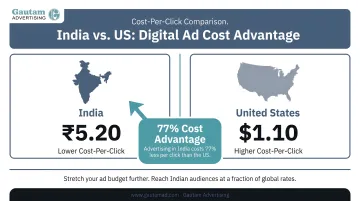
Google estimates businesses generate $2 in profit for every $1 spent on Google Ads, based on analysis of cost-per-click activity across advertisers. India's average CPC is 77% lower than the US average, making search advertising exceptionally accessible for Indian SMEs. This cost structure lets smaller businesses compete on the same platforms as larger players—at a fraction of the entry cost traditional media requires.
KPIs impacted:
- Cost per lead (CPL) becomes directly manageable through bid adjustments and targeting refinement
- Total campaign spend vs. revenue generated can be tracked to the rupee, enabling precise ROI calculation
- Budget utilization rate ensures every rupee spent aligns with performance thresholds set by the business
What Happens When Website Advertising Is Missed or Ignored
Businesses that opt out of website advertising face three compounding disadvantages:
- Shrinking visibility as competitors claim search traffic, social attention, and remarketing opportunities
- Missed audiences who research products online before buying anywhere
- No data feedback loop to guide smarter budget decisions
The visibility gap widens over time. Organic reach on Facebook collapsed from 16% in 2012 to 1-2% in 2025; Instagram organic reach dropped 12% year-over-year. Even businesses with strong organic followings reach only a fraction of their potential audience without paid amplification. Competitors who advertise consistently occupy the spaces where buyers make decisions — leaving non-advertisers out of the consideration set entirely.
Relying solely on organic or traditional channels misses the audience. Google's ZMOT study found that 84% of shoppers use online sources—search engines, review sites, comparison tools—in the path to purchase, consulting an average of 10.4 sources before deciding. Print-only strategies miss audiences who research products online even if they buy offline. Organic social strategies reach diminishing audiences as platform algorithms prioritize paid content.
No campaign data means no feedback loop. Without website advertising, businesses have no visibility into which messages resonate, which audiences convert, or where spend is wasted. Growth runs on intuition rather than benchmarks — harder to replicate and impossible to scale with confidence.
Best Practices to Get the Most from Website Advertising
Define Campaign Objectives Before Spending
Decide upfront whether your goal is brand awareness (impressions), lead generation (form fills), or direct conversion (purchases). This determines platform, format, and bidding strategy.
- Brand awareness campaigns prioritize reach and frequency; use CPM bidding on display networks or video platforms
- Lead generation campaigns optimise for form submissions; use CPA bidding on search or social platforms with lead forms
- Conversion campaigns track sales or sign-ups; use ROAS or Target CPA bidding with proper conversion tracking
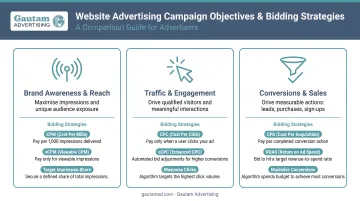
Misalignment here wastes budget. Running a brand awareness campaign with conversion-focused bidding drives up costs without results.
Use A/B Testing Systematically
Run variations of ad copy, visuals, and calls-to-action on small budgets first. Let data identify what works before scaling.
Testing framework:
- Test one variable at a time (headline, image, CTA)
- Run tests for minimum 2-4 weeks to account for weekly fluctuations
- Set statistical significance thresholds (minimum 100 conversions per variation)
- Scale winning variations; archive or rework losing ones
Companies that adopt A/B testing see conversion rate improvements of up to 35% on average. This prevents significant budget loss on unproven creative.
Integrate Website Advertising with Print and Other Media
Businesses that combine online ads with traditional channels achieve stronger brand recall and response rates than single-channel approaches. Website advertising excels in targeting and real-time tracking; print advertising builds credibility and reaches audiences not online.
The two channels reinforce each other when coordinated well:
- Print ads with QR codes or unique URLs drive traffic to measurable digital properties
- Website remarketing campaigns re-engage audiences who saw print placements but didn't convert immediately
- Coordinated messaging across channels reinforces brand recall and trust
Gautam Advertising has been building integrated media plans across print and digital channels since 1967 — placing ads across 10,000+ publications while aligning offline and online touchpoints to avoid channel overlap and wasted spend.
Review Performance Data Regularly and Act on It
Set a cadence—weekly or bi-weekly—to review performance dashboards and make adjustments.
Actions to take during reviews:
- Pause ad sets with CPA above your target threshold
- Reallocate budget from low-performing placements to high-performing ones
- Refresh creative every 1-2 weeks for high-spend accounts, 3-4 weeks for lower-spend accounts
- Adjust targeting parameters based on demographic and behavioural performance data
- Update landing pages if bounce rates exceed 60%
Meta recommends refreshing ad creatives every 1-2 weeks for high-volume accounts to prevent creative fatigue, where rising CPC and falling CTR signal declining ad effectiveness. The accounts that sustain performance longest are the ones treated as ongoing experiments, not set-and-forget deployments.
Conclusion
The value of website advertising comes down to three compounding advantages: precise reach to high-intent audiences, clear visibility into what's working, and cost control that ties spend directly to performance. Applied consistently, these advantages translate into measurable business growth.
Website advertising rewards businesses that treat it as an ongoing practice—reviewing data weekly, testing creative variations, and integrating digital campaigns with traditional channels where relevant. Consistent measurement and adaptation matter far more than budget size. The businesses that pull ahead are those that act on what the data actually shows.
Frequently Asked Questions
What are the advantages of website advertising?
Website advertising offers precise audience targeting, real-time performance tracking, and flexible budgeting through models like pay-per-click or pay-per-acquisition. Conversion potential is higher than most traditional formats because every campaign metric is measurable and adjustable.
What are the 10 advantages of advertising?
Key advantages span both brand-building and performance goals:
- Brand awareness, audience reach, and market visibility
- Sales growth, customer trust, and competitive positioning
- Precise demographic targeting and real-time measurability
- Cost efficiency through flexible budgets and active engagement tracking
Is website advertising better than print advertising?
Both have distinct strengths. Website advertising excels in targeting precision, real-time tracking, and budget scalability, while print advertising builds credibility and reaches audiences not active online. The most effective strategies integrate both—using print for trust and awareness, and digital for targeting and conversion tracking.
How much does website advertising cost for small businesses?
Costs vary widely by platform and model (PPC, CPM, CPA). Google Ads has no minimum daily budget; campaigns can start with ₹200–₹500 daily. According to Google Ads benchmarks, India's average CPC runs 77% lower than the US average, making search advertising highly accessible. The key is setting clear goals and scaling spend based on proven performance data.
How do I measure the success of my website advertising campaigns?
Success is measured through KPIs aligned to campaign objectives. Performance campaigns track CTR, conversion rate, CPA, and ROAS. Awareness campaigns track impressions, reach, and brand lift metrics. All data is available in real time via platform dashboards like Google Ads, Meta Ads Manager, and Google Analytics.
What are the best practices for website advertising?
- Define objectives upfront: awareness, leads, or conversions
- A/B test creative variations on small budgets before scaling
- Set targeting parameters based on audience research
- Review performance data weekly and adjust bids or placements
- Integrate digital ads with other channels, including print, for broader reach and credibility