Introduction
Running ads without a placement strategy is like putting up a billboard in an empty field: you may have a great message, but nobody's there to see it. Many advertisers face this exact challenge: wasted budgets on ads that appear in the wrong location, at the wrong time, or in front of the wrong audience. This guide covers everything you need to know about digital ad placement: what it actually means, the main ad formats and where they appear, and how to choose placements based on your goals.
We'll also share advanced optimization tips that can measurably improve your return on investment (ROI). Whether you're a business owner stretching your ad budget or a marketer refining your media strategy, smarter placement decisions start here.
Key Takeaways
- Digital ad placement is the strategic positioning of ads across websites, social feeds, apps, or video streams—where your target audience is most active
- Formats range from display and video ads to native, social, and mobile—each suited to different environments and campaign goals
- Placement choice depends on audience behavior, campaign goals, budget, and platform context—not just where space is available
- Tactics like A/B testing, frequency capping, contextual targeting, and retargeting sharpen placement performance over time
- Success requires continuous monitoring and optimization—not a set-and-forget approach
What Is Digital Ad Placement?
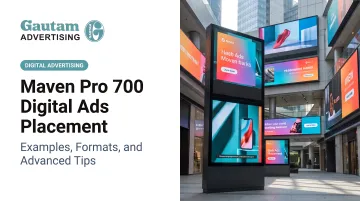
Digital ad placement refers to the strategic positioning of an advertisement within a specific location—such as a webpage, social media feed, video stream, or mobile app—where a target audience is likely to see and engage with it. Placement isn't just about "where" the ad appears on a screen; it also encompasses which platform, which page type, and which audience context surrounds the ad.
Three terms define how placement works in practice:
- Ad unit — the container holding your creative (the format itself)
- Ad slot — the physical location on a page, such as a top banner or sidebar
- Ad inventory — all available ad spaces a publisher has for sale
Understanding these distinctions helps advertisers make precise decisions about where their budget goes.
Even a brilliantly designed ad can fail if placed in the wrong context, on the wrong platform, or in the wrong position on a page. Poor placement wastes budget on impressions that never convert; strategic placement turns visibility into measurable action.
The stakes are real. In India's digital ad market, social media alone accounted for nearly ₹14,500 crore in ad expenditure in 2024—making placement decisions a direct competitive advantage, not an afterthought.
Major Digital Ad Formats and Placement Locations
Different ad formats are designed for different environments and user behaviors. Understanding each format helps advertisers match the right creative to the right placement, maximizing both engagement and budget efficiency.
Display and Banner Ads
Display and banner ads are the most widely used digital ad format—visual units (static or animated) placed on websites, typically at the top (leaderboard), sidebar (skyscraper), or within content (medium rectangle). Standard sizes include 728x90 (leaderboard), 300x250 (medium rectangle), and 160x600 (wide skyscraper), as defined by the IAB's standard ad specifications.
Key considerations:
- Above-the-fold placements command higher viewability and cost-per-thousand-impressions (CPMs)—research shows ads above the fold achieve about 73% viewability versus 44% below the fold
- Banner blindness is a real challenge; users often unconsciously ignore ads in predictable positions
- Creative quality and placement context are critical—ads that blend naturally with content while standing out visually perform best
- Global ad viewability reached 76.1% in 2024, but placement position significantly affects these rates
Video Ads
Video ads fall into two main categories: in-stream and outstream. In-stream video ads (pre-roll, mid-roll, post-roll) play inside a video player—think YouTube ads before or during content. Outstream video ads appear outside a dedicated player, often auto-playing within article content on news sites or blogs.
In-stream ads tend to have higher completion rates because users expect them and are already engaged with video content. Outstream ads offer more flexible placement on content-heavy sites but may face lower completion rates if they interrupt the reading experience. Globally, video now accounts for nearly 60% of TV and video ad spend, reflecting the format's effectiveness at capturing attention and driving action.
Native Ads
Native ads are designed to match the surrounding content—appearing as sponsored articles, in-feed posts, or content recommendations (like "You may also like" widgets at the bottom of articles). They're valued for their non-disruptive user experience and typically deliver higher click-through rates than standard display banners.
Because native ads match the form and function of the platform they appear on, users engage with them more naturally. A fashion brand's native ad in an Instagram feed, for example, looks and feels like regular content, making it more likely to be clicked. Globally, native display ad spending is forecast to grow 13.1% in 2026, a sign the format continues to gain advertiser trust.
Social Media Ads
Social media placements offer precision targeting by demographics, interests, and behaviors, making them highly efficient for reaching defined audiences. Major placement types include:
- Facebook/Instagram Feed ads – appear natively in users' scrolling feeds
- Instagram Stories – full-screen vertical ads between user stories
- LinkedIn Sponsored Content – especially effective for B2B audiences in a professional context
- YouTube pre-rolls – video ads before user-selected content
Each platform serves different audience contexts: LinkedIn for professional and B2B audiences, Instagram for lifestyle and visual products, Facebook for broad consumer reach across demographics.
Mobile Ads
Mobile ad placements include mobile web banners, in-app banners, interstitials (full-screen ads between app actions), and rewarded video ads (user-initiated in exchange for in-app rewards like game currency). Across major markets, mobile accounted for over 65% of all digital ad spending in 2024, reflecting where audiences spend most of their online time.
Mobile placement best practices:
- Use mobile-responsive creative that loads quickly (slow load times kill engagement)
- Optimize for vertical formats, especially for Stories and in-app placements
- Consider user intent—rewarded videos work well in gaming apps where users opt in; interstitials perform better at natural app breaks
How to Choose the Right Ad Placement for Your Campaign
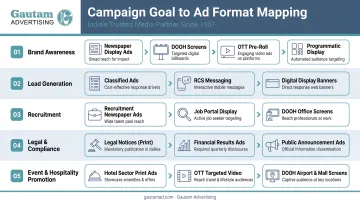
No single placement format works for all goals—placement choice must follow campaign objective. Here's how to map your goals to the right placements:
- Brand awareness → Display and social feed ads for maximum reach
- Intent capture → Search ads and in-content native placements
- Engagement and conversion → Retargeted display or social ads
- Video storytelling → In-stream or outstream video placements
Audience and Platform Alignment
Placement decisions should follow where your target audience actually spends time online. Match platform to audience type:
- B2B brands → LinkedIn, where decision-makers engage with professional content
- Youth and lifestyle brands → Instagram and YouTube, where visual storytelling thrives
- Mass-market consumer brands → Facebook and display networks for broad reach
Timing matters too. Research when your audience is most active on each platform and schedule placements accordingly. Evening hours tend to work best for B2C products, while business hours capture B2B attention.
Above-the-Fold vs. Below-the-Fold
Above-the-fold placements (visible without scrolling) offer higher viewability and are priced at a premium CPM. Google's research found that ads above the fold had about 73% viewability compared to 44% below the fold—a significant difference that affects whether users actually see your ad.
However, below-the-fold placements can still perform well on content-heavy pages with high scroll-through rates. If you're working with a tighter budget, assess scroll-rate data before assuming above-the-fold is always worth the premium. On articles with 80%+ scroll depth, mid-page placements can deliver competitive performance at lower cost.
Contextual Targeting and Ad Adjacency
Contextual targeting means placing ads on pages whose content aligns with the ad's subject matter—for example, a travel ad on a travel blog—increasing relevance for the user. 66% of contextual ad buyers planned to boost investments in 2024, as privacy changes make contextual signals more valuable than third-party data.
Ad adjacency risk is the danger of ads appearing next to inappropriate, competitor, or irrelevant content, which can harm brand perception. 83% of US digital media experts say brand safety will be an increasing concern as video ad volume grows. Use exclusion lists and work with verified platforms to protect brand safety.
Budget, CPM, and Format Trade-offs
Placement choices directly impact cost:
- Video and premium above-the-fold inventory are expensive but high-impact
- Mobile and native placements can deliver competitive performance at lower CPMs
- Below-the-fold and in-content placements offer budget-friendly alternatives when scroll rates are high
Understand the relationship between cost-per-click (CPC), cost-per-thousand-impressions (CPM), and your campaign KPIs. For businesses navigating these trade-offs, working with an agency that has established publisher relationships can make a measurable difference. Gautam Advertising, INS-accredited since 1976 and connected to 10,000+ publications across India and internationally, brings placement negotiation expertise across both print and digital media to help clients secure competitive rates without budget overrun.
Advanced Tips to Maximize Ad Placement Performance
These tactics go beyond the basics, giving advertisers who've mastered the fundamentals concrete ways to push performance further.
A/B Test Placements Systematically
A/B testing placement means running the same creative in two different positions (for example, in-content vs. sidebar, above-fold vs. mid-page) simultaneously and comparing click-through rate (CTR), conversion rate, and engagement. Meta recommends running A/B tests for at least 7 days to avoid inconclusive results, while Google suggests at least 2 weeks to reach statistical power.
Best practices:
- Test one variable at a time to isolate what's driving performance differences
- Ensure statistically significant sample sizes before drawing conclusions
- Document results to build institutional knowledge over time
Use Frequency Capping to Prevent Ad Fatigue
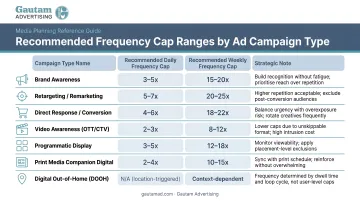
Frequency capping limits the number of times the same user sees the same ad within a defined time window (for example, 3 times per day). Over-exposure leads to banner blindness or brand annoyance, wasting impressions on users who've already decided not to click.
Recommended frequency caps by campaign type:
- Awareness campaigns: 1-2 impressions per week (focus on reach, not repetition)
- Retargeting campaigns: 3-5 impressions per week (higher frequency acceptable for warm audiences closer to conversion)
- Seasonal or promotional campaigns: 5-7 impressions per week during short campaign windows
Leverage Retargeting for Warm Audiences
Retargeting (also called remarketing) re-engages users who have previously visited your website or interacted with your brand but did not convert. Retargeted placements typically see higher conversion rates than cold-audience placements because you're reaching people who've already shown interest.
It requires a tracking pixel on your website and works across display networks, social platforms, and search. Common use cases include showing product ads to cart abandoners or nudging blog readers toward a resource download or demo request.
Build a Cross-Platform Placement Strategy
A user rarely converts on first exposure—they often encounter a brand across multiple touchpoints before taking action. Map out how placements work sequentially:
- Awareness stage: Social feed ads or YouTube video introduce your brand
- Consideration stage: Native ads or in-content placements educate and build trust
- Conversion stage: Search ads or retargeted display ads drive final action
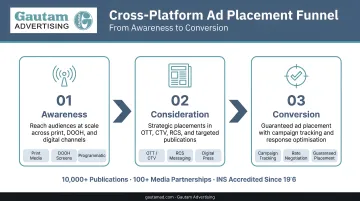
Keep visual identity, tone, and core value proposition consistent across all platforms — even as creative adapts to each format, the brand should remain instantly recognizable.
Use Heatmaps and Analytics to Identify True Engagement Zones
Heatmap tools identify which areas of a webpage users actually look at and scroll to—revealing optimal placement zones beyond just "above the fold." Combine this with platform analytics (bounce rate, time-on-page, scroll depth) to continuously refine where on a page ads should appear.
This is especially useful for advertisers managing their own sites or buying placements on specific content pages. If heatmaps show users consistently engage at 40% down the page, an in-content placement there will often outperform a traditional above-fold banner.
Measuring Whether Your Ad Placements Are Working
Track these key performance metrics to evaluate ad placement effectiveness:
- Click-Through Rate (CTR) – measures how many viewers click the ad
- Viewability Rate – percentage of ad impressions where the ad was actually seen (not just loaded); the MRC/IAB standard defines a viewable display impression as at least 50% of pixels in view for 1 continuous second
- Conversion Rate – percentage of clicks that result in a desired action
- Cost Per Acquisition (CPA) – total spend divided by number of conversions
- Return on Ad Spend (ROAS) – revenue generated per ₹1 spent on ads
No single metric tells the full story. CTR alone can be misleading if clicks don't convert, and high impressions mean little if viewability is low. A dashboard approach — tracking all core metrics together, broken down by placement type and platform — gives you an accurate read across channels.
Review cadence:
- Weekly reviews to catch underperforming placements early and reallocate budget
- Monthly deep-dives to identify broader patterns and test new placement strategies
Campaigns that get reviewed and adjusted regularly consistently outperform those left to run without intervention. Build the review habit in from the start.
Frequently Asked Questions
What is advertising placement?
Advertising placement is the strategic positioning of an ad in a specific location—such as a website, social media feed, or mobile app—to maximize its visibility and relevance to the target audience. It determines both the channel and the exact position within that channel.
What does placement mean in advertising and marketing?
In advertising, "placement" refers to both the channel (such as Google, Facebook, or a news website) and the specific position within that channel (such as top-of-page, in-feed, or pre-roll video) where an ad appears. Where your ad appears shapes how audiences perceive and respond to it.
What is the best ad placement for a website?
Above-the-fold placements (leaderboard at the top, medium rectangle within content) generally deliver the highest viewability and CTR. However, in-content and sticky footer placements also perform well depending on the website's layout and audience scroll behavior.
What are the main types of advertising?
The main digital ad types are display/banner ads, video ads, native ads, social media ads, and search ads. Each suits different goals — search ads capture active intent, while display and video build awareness across broader audiences.
What is an example of product placement advertising?
Product placement is when a brand's product appears naturally within content—such as a branded drink featured in a film or a sponsored article on a news site—integrating the brand into the content experience rather than appearing as a standalone display ad.
How much does advertising placement cost?
Costs vary by format and platform. Search ads typically use CPC (cost-per-click) pricing, while display and video ads use CPM (cost per thousand impressions). Actual rates depend on competition, targeting, and industry.