Introduction
The mobile gaming market has reached a scale few industries can match: 3.0 billion mobile gamers worldwide in 2025, generating $103.0 billion in revenue, roughly 55% of the total gaming market. With approximately 264,000 mobile gaming apps competing for attention on Google Play alone, advertising isn't optional. It's the primary engine of growth and user acquisition.
Mobile game advertising looks simple on the surface: pick a platform, run some ads, track results. In practice, outcomes vary sharply based on format choices, targeting precision, creative quality, and channel mix. Post-privacy changes have shrunk traditional targeting signals, pushing user acquisition costs higher across the board.
This guide covers a proven step-by-step advertising strategy, the most effective ad formats, the top channels for game promotion, and the key variables that determine campaign success. The goal: help you spend smarter, reach the right players, and drive measurable returns from your campaigns.
Key Takeaways
- Combine paid channels (ad networks, social platforms) with organic strategies (ASO, social media) for optimal results
- The four highest-performing formats are rewarded ads, playable ads, interstitial ads, and banner ads—each suited to specific game types and goals
- Define your target audience before spending a single cent; accurate audience profiling is the foundation of campaign success
- Rewarded and playable ads outperform passive formats in engagement and conversion—at the cost of higher creative investment
- Campaigns that scale rely on continuous testing, regular creative refresh, and consistent performance measurement
How to Advertise a Mobile Game: Step-by-Step
Step 1: Define Your Target Audience and Campaign Goals
Many developers skip proper audience research and waste budget attracting players who install but never engage. The mobile gaming audience today is far more diverse than the outdated stereotype of young males. According to 2025 data from the Entertainment Software Association, women account for 47% of U.S. gamers, while the average player age is 36 years old—with 82% of all U.S. players using mobile devices. Among female players specifically, 86% play on mobile, and Gen X (ages 45-60) has the highest mobile play rate at 87%.
Defining campaign goals means more than saying "get more downloads." Are you optimizing for:
- Cost per install (CPI): driving volume of downloads
- Day-1/Day-7/Day-30 retention: acquiring engaged players who stick around
- In-app purchases (IAP): attracting users who actually spend
- Ad revenue (eCPM): building an audience that engages with in-game ads
Your goal shapes every decision downstream — format selection, bidding strategy, platform choice, and success metrics. A campaign optimized purely for CPI will attract very different users than one targeting retention or IAP.
Before launching new ads:
- Review existing player data from your analytics platforms
- Examine App Store Connect or Google Play Console demographics
- Analyze historical campaign results to identify best-performing player segments
- Build an audience profile covering age range, gender, geography, device types, and spending behavior
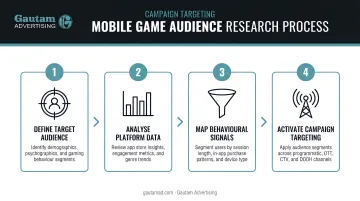
This upfront research ensures your targeting matches your ideal player profile, reducing wasted spend on users who churn within 24 hours.
Step 2: Set Your Budget and Select Your Channels
The golden rule: spread budget across multiple channels rather than concentrating all spend in one network. Split budget between proven channels (Meta, Google) and experimental ones (TikTok, Apple Search Ads) to balance predictability with discovery. This prevents over-dependence on any single network's algorithm changes — and often uncovers high-performing channels specific to your game genre.
User acquisition costs have risen sharply following Apple's ATT framework and Android privacy changes. From Q1 2023 to Q2 2024, Android CPI jumped 48%, while iOS CPI remains approximately 3.5 times higher than Android. Gaming apps spent $25 billion on user acquisition in 2025, reflecting the competitive pressure driving costs upward.
For developers with limited budgets, these rising costs demand tighter targeting and smarter channel selection. Smaller budgets cannot afford to spread too thin across six networks simultaneously — start with 2-3 channels, accumulate enough data to optimize, then expand.
For developers unfamiliar with media planning, working with an experienced advertising agency can help you identify the right channel mix faster. Agencies with deep media relationships — particularly those covering print, OOH, and digital placements — can complement your digital user acquisition strategy by building broader brand awareness across offline touchpoints your competitors may be ignoring.
Step 3: Choose Your Ad Formats and Build Creatives
Format selection must align with both game genre and campaign goal. Casual single-screen games (match-3, endless runners) work well with banner ads for continuous exposure. Level-based games (puzzles, strategy) benefit from interstitials placed between levels. Games with in-game economies (RPGs, simulation games) are natural fits for rewarded ads that offer players currency or power-ups.
What makes a high-performing mobile game creative:
- Capture attention in the first three seconds — users decide immediately whether to scroll past
- Use a clear call-to-action: "Download Now," "Play Free," or "Start Your Adventure"
- Show accurate gameplay footage that matches the real experience (misleading ads drive uninstalls)
- Tailor creatives to each platform's technical specs and audience behavior — a TikTok ad and a Meta ad for the same game should look different
Creative fatigue is real. Performance of even the best ad creative decays over time as audiences see it repeatedly. According to Liftoff's 2025 research, advertisers who introduce user-generated content (UGC) to campaigns see an average 152% increase in impression-to-install conversion rates. Continuously refresh ad creatives and test multiple variations simultaneously rather than relying on a single "winning" creative indefinitely.
Step 4: Launch, Measure, and Optimize
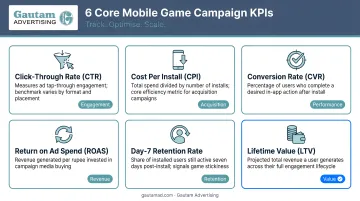
Once your campaign launches, track these core KPIs:
- CPI (cost per install): what you pay per download
- CTR (click-through rate): percentage of users who click your ad
- ROAS (return on ad spend): revenue generated per ₹ spent
- Day-1/Day-7/Day-30 retention: percentage of users still playing after 1, 7, and 30 days
- eCPM (effective cost per mille): revenue per thousand ad impressions, for monetization-focused campaigns
- Session length changes: whether new users are engaging deeply or bouncing quickly
Apply A/B testing methodology: test one variable at a time — audience segment, creative variation, ad format, or placement — and use results to iteratively refine the campaign. Changing multiple variables at once makes it impossible to know what actually drove the result.
Implement frequency capping from day one. Overexposing users to the same ad leads to banner blindness and negative brand association. Start with conservative frequency caps (3-5 impressions per user per day) and increase carefully while monitoring retention metrics. If Day-1 retention drops as frequency increases, you've hit the saturation point.
Key Mobile Game Ad Formats and When to Use Them
No single format works universally. The best results come from mixing formats strategically based on game type, user behavior stage, and monetization model.
Banner Ads
Banner ads are rectangular static or animated ads anchored to the top or bottom of the screen. They're easy to implement, low-cost, and non-intrusive, making them best suited for casual and single-screen games where maximizing ad exposure without disrupting gameplay is the priority.
Limitation: Banner blindness means they generate impressions and awareness rather than high conversions. Use them as a passive revenue layer alongside higher-engagement formats, not as your primary user acquisition driver.
Interstitial Ads
Interstitials are full-screen ads that perform best at natural transition points—between levels, after a boss defeat, or at the end of a game loop. These moments represent natural pauses when players expect a brief break, making the ad less intrusive.
Critical warning: Showing interstitials at the start of a level or during active play creates frustration and increases churn. The placement decision is as important as the creative itself. Poor placement will spike abandonment rates regardless of creative quality.
Rewarded Ads
The rewarded ad model is simple: users voluntarily watch an ad in exchange for an in-game reward (extra lives, coins, power-ups, bonus attempts). This opt-in nature makes it the most player-friendly format and typically delivers the highest eCPMs.
According to Unity's research, users who engage with rewarded ads are 4.5 times more likely to make an in-app purchase versus those who do not. These users also show 3.5x higher retention than non-engaged users. The value exchange—reward for attention—creates a positive user experience that improves rather than harms retention.
Best for: Games with consumable economies, mid-core and casual games where players regularly need resources.
Playable Ads
Playable ads let potential players experience a mini-version of your game directly within the ad unit. This closes the gap between seeing an ad and understanding gameplay, leading to higher quality installs and better Day-1 retention.
Research from Liftoff found that for non-top-spending apps, the impression-to-install conversion rate for playable ads is 16x higher than non-playable formats. Top-spending apps allocate over 35% more budget to playable ads than other advertisers, reflecting their proven performance.
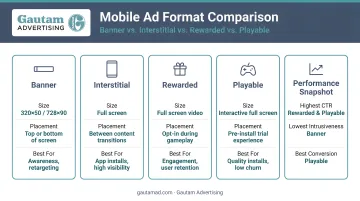
Trade-off: Playable ads are costlier and more technically demanding to produce—requiring development resources to build the playable experience. However, they consistently deliver superior conversion rates and are particularly effective for puzzle, casual, and action games where core mechanics can be demonstrated quickly.
Video and Storytelling Ads
Video ads (15-30 seconds) are powerful tools for conveying gameplay feel, emotional tone, and game world atmosphere. Storytelling-driven video ads that build a mini-narrative rather than just showing gameplay clips tend to create stronger emotional connection and memorability.
Keys to success:
- Lead with a hook in the first three seconds — most viewers decide within that window
- Use a high-quality thumbnail to drive initial clicks
- Build toward a narrative arc rather than stringing unrelated gameplay clips
- Close with a direct, specific call-to-action
Production quality matters here more than in any other format. A weak video ad signals a weak game — so budget accordingly, or hold off until the creative is genuinely competitive.
Best Ad Networks and Channels for Mobile Games
Different networks suit different games, budgets, and goals. The right mix depends on your platform (iOS vs. Android), target geography, and campaign objective.
Meta (Facebook/Instagram)
Meta houses approximately 135,000 game advertisers and remains one of the most widely used networks for initial CPI testing. Its detailed demographic, behavioral, and interest-based targeting—while diminished post-IDFA—still provides a strong starting point for most mobile game advertisers.
Across Facebook, Instagram, Messenger, and Audience Network, Meta accounts for more than 69% of social gaming impression share—up from roughly 54% the prior year. With over 3 billion monthly active users, that reach translates to real volume for both broad and niche player segments.
Best for: Initial CPI campaigns, broad audience testing, social and casual games with wide demographic appeal.
Google Ads (including UAC and AdMob)
Google's Universal App Campaigns (UAC) are particularly powerful for Android games, with reach extending across Google Play, YouTube, Search, and AdMob. YouTube is especially valuable for video and storytelling ad formats that require longer narratives.
On Android, Google AdMob holds 24% of ad revenue share, making it the largest single ad monetization network on the platform. That dual role—user acquisition through UAC and monetization through AdMob—makes Google worth prioritizing for Android-first developers.
Best for: Android games, video-heavy campaigns, developers seeking cross-Google ecosystem reach.
Unity Ads and ironSource
Built specifically for gaming, Unity Ads and ironSource (now merged into the LevelPlay platform) support every major ad format—playable, rewarded, and video—with genre-based audience targeting that generalist networks can't replicate.
Unity Ads commands 13% of iOS ad revenue share in mobile games (third-largest on iOS) and 12% on Android. The platform's deep integration with game development tools (Unity engine) provides technical advantages and audience understanding other networks cannot match.
Best for: All game genres, developers using Unity engine, campaigns requiring genre-specific targeting.
Apple Search Ads
Apple Search Ads is the primary channel for targeting iOS users directly on the App Store. It's an auction-based system where higher-value iOS users come at a premium cost, but the intent signal is exceptionally strong—users searching the App Store are actively looking for new games.
Mobile games have an average Apple Search Ads conversion rate of 68%—significantly higher than most display formats. That figure also means your CPI budget works harder here than on most other channels, provided your game can absorb the premium acquisition cost.
Best for: iOS games, high-LTV titles that can absorb premium CPI, keyword-targeted campaigns.
Key Variables That Affect Mobile Game Ad Campaign Results
Two campaigns with identical budgets can produce dramatically different outcomes. Results are determined by controllable variables that must be actively monitored and adjusted.
Creative Quality and Format Relevance
The ad creative is the single most influential factor in CTR and conversion. A misleading, low-quality, or poorly matched creative attracts the wrong users and inflates CPI without improving retention.
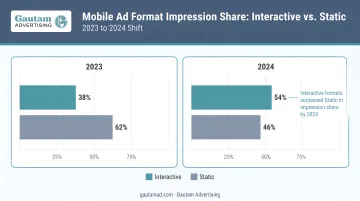
Data shows interactive creatives outperform static formats. Playable ads' impression share nearly doubled in one year, rising from 6.3% to 13.3%, while static image ads fell from 48.9% to 33.0%. Advertisers are following the performance data: interactive formats simply work better for user acquisition.
The creative must also accurately represent the actual game experience. Deceptive ads generate installs but produce catastrophic retention rates and negative reviews — a short-term gain that poisons long-term growth.
Targeting Precision in a Post-Privacy Landscape
Apple's ATT framework and Google's Privacy Sandbox have reduced access to user-level data, making broad targeting far less precise. Contextual targeting, based on game genre, content type, and platform behavior, has become the most reliable alternative.
Poor targeting wastes budget on users who install but don't engage. The most effective signals to prioritize:
- Genre affinity — users already playing similar titles
- Device type — matching hardware specs to your game's requirements
- Engagement patterns — active players, not passive scrollers
- Lookalike audiences — modeled on your highest-retention existing players
Focus on quality over volume. A thousand engaged players are worth far more than 10,000 who uninstall within 24 hours.
Ad Placement Timing and Frequency
When an ad appears within a game session, and how often, directly affects both player experience and conversion potential. Ads shown at the wrong moment, mid-action or at level start, spike abandonment rates.
Natural pause points, such as between levels, after failure states, or at session end, consistently outperform mid-session placements. Frequency capping is equally important: users who see the same ad 15 times in one session develop banner blindness and negative brand associations that erode CTR over time.
Budget Allocation and Bidding Strategy
Spreading budget too thin across too many networks prevents any single channel from accumulating enough data to optimize. Over-concentrating on one channel creates the opposite risk: algorithm changes or policy updates can devastate campaigns overnight.
Start with a test budget on 2-3 networks, measure ROAS and retention per channel, then scale spend on proven performers. This staged approach lets each network's algorithm learn your best audience while maintaining diversification.
Avoid splitting budget evenly across six channels from day one. Concentrate enough spend per channel to generate statistically significant results — typically ₹50,000–₹1,00,000 minimum per channel per month for meaningful optimization.
Common Mistakes in Mobile Game Advertising
Avoiding the following mistakes can mean the difference between campaigns that drain budget and ones that build a sustainable player base.
Targeting too broadly without a player profile. Broad targeting inflates install volume but destroys retention. A campaign delivering 10,000 installs at ₹30 CPI with 10% Day-1 retention performs far worse than one delivering 2,000 installs at ₹50 CPI with 40% Day-1 retention. Installs are a vanity metric — engaged players are not.
Relying on a single ad format or network. Committing to only banner ads, or running everything through one platform, caps both reach and learning. Diversifying across networks reveals your optimal channel mix. It also protects against algorithm changes or policy updates that can derail single-channel campaigns overnight.
Ignoring App Store Optimization alongside paid spend. Paid ads drive users to your App Store page — if that page isn't built to convert, you waste every rupee of acquisition budget. App Store Optimization (ASO) covers your game title, description, keywords, screenshots, and ratings. Sensor Tower's 2021 download sources report found that 35% of mobile game downloads came from search — organic discovery runs alongside paid, not separately from it.
Running the same creative until it dies. Creative fatigue is real and measurable — performance drops before most advertisers notice. Mobile game campaigns need a continuous pipeline of new variants. Top advertisers test 5–10 creative variations simultaneously and refresh underperformers every week, not every quarter.
Frequently Asked Questions
How do ads work on mobile games?
Ads in mobile games are served through ad networks like Google AdMob or Unity Ads, integrated into the game's code via SDK (software development kit). They appear at predefined placements—banners anchored on screen, interstitials between levels, or opt-in rewarded ads—and generate revenue for developers on a CPM, CPC, or CPA basis depending on the monetization model selected.
How do I promote my mobile game?
Mobile game promotion combines paid advertising (Meta, Google, Unity Ads, Apple Search Ads) with organic efforts like App Store Optimization, influencer partnerships, and community building. The most successful campaigns run both tracks simultaneously rather than treating them as alternatives.
How much does it cost to advertise a mobile game?
Costs vary widely by platform and geography. According to 2026 benchmarks, iOS CPI averages approximately ₹390 ($4.70) per install versus ₹280 ($3.40) on Android. Regional gaps are significant — North America averages ₹440 ($5.28) per install, while APAC averages just ₹77 ($0.93).
What is the best ad format for mobile games?
Rewarded ads and playable ads consistently outperform other formats — rewarded ads drive 4.5x higher in-app purchase rates, while playable ads achieve 16x higher impression-to-install conversion than passive video. That said, the right choice depends on your genre and campaign goal: awareness campaigns suit video, while retargeting works better with interstitials.
How much is a 30-second ad worth?
A 30-second in-game video ad is valued by eCPM (earnings per thousand impressions). According to Business of Apps data, rewarded video averages ₹875 ($10.50) eCPM versus ₹540 ($6.50) for in-stream video. Geography moves rates considerably — APAC averages ₹375 ($4.50) while North America reaches ₹540 ($6.50).