
Introduction
A Notice of Motion is a formal written application filed by a party in a High Court proceeding, notifying both the court and the opposing party of a specific relief or order being sought. For litigants, legal professionals, and businesses navigating High Court proceedings in India, understanding this tool is essential.
It applies across a range of situations — seeking a temporary injunction to protect business assets, applying for bail in a criminal matter, or requesting the court to quash an FIR. In each case, it serves as the primary mechanism for obtaining interim relief during ongoing litigation.
This article explains what a Notice of Motion is, when it is used, and how the process works step-by-step in the High Court. It also covers how it differs from related tools like petitions and chamber summons, what happens at each stage from filing to hearing, and the procedural rules that govern its use.
Key Takeaways
- A Notice of Motion requests specific interim relief in pending High Court proceedings, served with advance notice of the hearing date
- Used for temporary injunctions, bail applications, stay orders, and FIR quashing petitions
- Requires drafting, filing, service on all parties, and newspaper publication when respondents are untraceable
- Differs from petitions (which initiate cases) and chamber summons (heard privately without public notice)
- Courts grant relief only after testing for a prima facie case, balance of convenience, and irreparable harm
What Is a Notice of Motion?
A Notice of Motion is a procedural document in Indian High Court practice that formally alerts the court and the respondent that the applicant will move the court on a specified date to seek a particular order. Unlike a petition that initiates fresh proceedings, a Notice of Motion operates within existing litigation to secure interim or procedural relief.
Legal Foundation and Governing Rules
The Notice of Motion derives its authority from the Code of Civil Procedure, 1908 (CPC), particularly:
- Order 39 Rules 1-3: Governs temporary injunctions and interlocutory orders
- Order 6 Rule 17: Governs amendment of pleadings
- High Court Original Side Rules: Each High Court — Bombay, Delhi, Calcutta — maintains its own specific procedural rules
Order 39 Rule 3 mandates that courts must give notice to the opposite party before granting injunctions, except where delay would defeat the relief sought. This requirement upholds the natural justice principle of audi alteram partem—the right to be heard—established in the landmark Maneka Gandhi v. Union of India (1978) case.
Purpose and Natural Justice
The Notice of Motion mechanism ensures procedural fairness by:
- Providing adequate notice to the opposing party
- Allowing the respondent an opportunity to be heard
- Preventing arbitrary or one-sided court orders
- Ensuring transparency in judicial proceedings
This fairness framework applies across both civil and criminal proceedings, each with its own set of typical applications.
Two Broad Contexts of Use
Civil Proceedings:
- Temporary injunctions and stay orders
- Amendment of pleadings
- Discovery and production of documents
- Interim custody or maintenance applications
Criminal Proceedings:
- Bail and anticipatory bail applications
- Quashing of FIR under Section 528 of the Bharatiya Nagarik Suraksha Sanhita (BNSS), 2023
- Discharge applications
- Transfer of cases between courts
How It Differs from a Petition
The distinction is fundamental:
| Notice of Motion | Petition |
|---|---|
| Filed within pending proceedings | Initiates fresh proceedings |
| Seeks interim/procedural relief | Invokes court's jurisdiction on substantive matter |
| Interlocutory in nature | Decides main rights and obligations |
| Does not dispose of main suit | Can result in final judgment |
In practice, confusing the two can result in the wrong document being filed — which courts may reject or treat as an irregularity. Knowing which applies to your situation determines how quickly relief can be sought.
How Does a Notice of Motion Work in the High Court?
The Notice of Motion process follows a structured sequence: drafting → filing → service → publication (when required) → hearing → order.
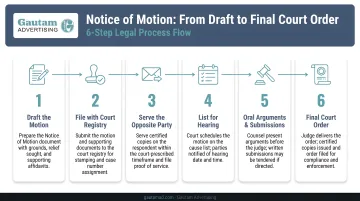
Once filed, the court assigns a hearing date. Both parties present arguments on that date, after which the judge may grant ex-parte interim relief (if urgent), issue notice for a full hearing, or pass a final order on the motion. Failure to properly serve the Notice on all parties is grounds for denial of relief or adjournment at the applicant's cost.
Step 1: Drafting the Notice of Motion
The applicant's advocate prepares the Notice of Motion document containing:
- Case title and number: Full party names as they appear in the main suit
- Relief sought: Specific, precise order requested from the court
- Legal grounds: CPC provisions or High Court rules justifying the relief
- Hearing date: The returnable date (at least 7 days from service in Bombay HC, 4 days in Delhi HC)
- Supporting affidavit: Sworn statement of facts with documentary evidence attached as exhibits
The affidavit carries the evidentiary weight of the entire motion. Courts will not grant relief based on the notice alone: it must state facts within the applicant's personal knowledge, avoid legal conclusions, and attach relevant documents such as contracts, FIRs, lower court orders, or photographs.
Step 2: Filing with the High Court Registry
The motion is filed at the High Court's filing counter with required court fees and stamp duty. The registry scrutinises the document for compliance with:
- Proper format and form requirements
- Correct fee payment
- Proper verification and oath
- Annexure of required documents
Different High Courts have specific procedures under their Original Side Rules:
- Bombay High Court: Uses Form 13 under Chapter IXA (Rules 121 IXA - 134 IXA), requires 7-day default notice
- Delhi High Court: Follows Chapter IX of OS Rules 2018, requires 4-day counter-affidavit deadline
- Calcutta High Court: Uses "Interlocutory Application" terminology with 48-hour notice requirement
- Allahabad High Court: Terms it "Civil Miscellaneous Application" with 24-hour writ motion notice
Step 3: Service on the Opposing Party and Publication
After filing, the Notice must be served on the respondent personally or through their advocate. When the respondent's address is unknown or court rules mandate it, notice must be published in a newspaper.
Substituted Service by Newspaper:
Under Order 5 Rule 20 CPC, when ordinary service is impossible, courts order newspaper publication following specific requirements:
- Publication must be in newspapers from the High Court's approved list
- The Presiding Officer (Judge) personally selects the newspaper
- Vernacular papers are preferred (language of subordinate courts)
- Papers must have wide circulation in the district where the person resides
- The newspaper manager must send immediate confirmation and a marked copy to the court
Meeting these publication requirements demands familiarity with court-approved newspaper lists and strict scheduling. Gautam Advertising, an INS-accredited agency since 1976, handles legal notice publication across its network of 10,000+ publications — ensuring notices appear in the correct papers, on time, with confirmation copies filed as required by courts.
Step 4: Hearing and Order
On the hearing date:
- Both parties present oral arguments supported by their affidavits
- The judge evaluates whether the applicant has satisfied the legal test
- The court then issues one of three outcomes:
- Ad-interim order: Urgent temporary relief granted for a short period pending a full hearing
- Notice for full hearing: The matter is scheduled for detailed argument on merits
- Final order: Relief is either granted or refused on the motion itself
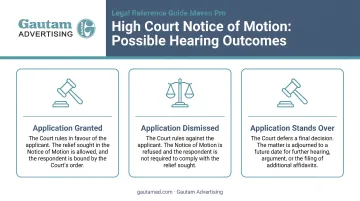
The signed written order is filed with the registry and served on all parties, completing the motion process.
When and Why Is a Notice of Motion Filed?
Common Situations Requiring a Notice of Motion
Civil matters:
- Seeking temporary injunction to prevent property damage or alienation
- Obtaining stay of lower court proceedings
- Amending plaint or written statement
- Requesting discovery or production of documents
- Securing interim maintenance or custody
Criminal matters:
- Applying for regular or anticipatory bail
- Quashing FIR or charge sheet under Section 528 BNSS
- Seeking discharge from criminal proceedings
- Requesting transfer of case to another court
Of the civil reliefs above, temporary injunctions are among the most frequently contested. Courts don't grant them lightly.
The Triple Test for Temporary Injunction
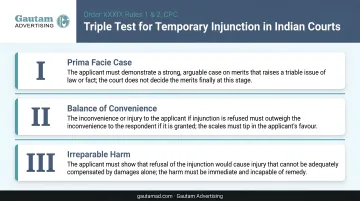
In Dalpat Kumar v. Prahlad Singh (1992) 1 SCC 719, the Supreme Court established that courts must be satisfied of all three conditions conjunctively before granting a temporary injunction:
- Prima facie case: A substantial question requiring investigation and decision on merits (not necessarily prima facie title)
- Irreparable injury: Material injury that cannot be adequately compensated by damages
- Balance of convenience: The mischief or injury from refusing the injunction outweighs the injury from granting it
If even one condition fails, the court will deny the injunction—regardless of how strong the other two appear.
When a party cannot wait for the other side to be heard, they may seek ex-parte ad-interim relief — but courts apply strict scrutiny in those cases.
Ex-Parte Ad-Interim Relief: Exceptional Circumstances Only
In Morgan Stanley Mutual Fund v. Kartick Das, 1994 SCC (4) 225, the Supreme Court laid down seven factors courts weigh before granting ex-parte relief:
- Whether irreparable or serious mischief will ensue
- Whether refusal would involve greater injustice than granting it
- Time at which plaintiff first had notice of the act
- Whether plaintiff acquiesced for some time
- Applicant must show utmost good faith
- Ex-parte injunction must be for limited period
- General triple-test principles also apply
Procedural compliance is equally critical. In Time City Infrastructure v. State of UP (August 2025), the Supreme Court held that failure to comply with Order 39 Rule 3 — recording reasons and serving the opposite party immediately — renders the ex-parte injunction automatically void.
Quashing Criminal Proceedings Under BNSS Section 528
Section 528 BNSS (replacing CrPC Section 482) preserves High Courts' inherent powers to prevent abuse of process. In Pradeep Kumar Kesarwani v. State of UP (September 2025), the Supreme Court laid down a four-step test:
- Is the material relied upon sound, reasonable, and indubitable?
- Does it rule out the factual assertions in the charges?
- Has the prosecution refuted this material?
- Would proceeding with trial result in abuse of process?
If all four answers are affirmative, the High Court should quash the proceedings. Together, these legal standards shape when a notice of motion is not just appropriate — but necessary.
Key Elements of a Valid Notice of Motion
Mandatory Components
A properly drafted Notice of Motion for Indian High Courts must contain:
Case identification:
- Case title, court name, case number
- Names of all parties as they appear in the main proceeding
Relief and grounds:
- Specific relief or order sought, framed precisely
- Legal grounds and CPC/rule provisions cited
Procedural details:
- Scheduled date and time of hearing
- Advocate's signature and enrolment details
Evidentiary support:
- Supporting affidavit sworn by the deponent
- Facts stated within personal knowledge
- Documentary evidence attached as exhibits
The Supporting Affidavit: Evidentiary Backbone
Under Bombay High Court Original Side Rules, Chapter XII (Rules 190-209):
Format requirements include:
- Drawn in first person, divided into numbered paragraphs each covering distinct subject matter
- States deponent's occupation, nationality, and place of abode
- Sworn before authorised officers under Section 139 CPC
- Every exhibit dated and initialled by the swearing officer
Content requirements include:
- Facts stated within personal knowledge only — no legal conclusions or argumentative statements
- Documentary evidence properly marked and attached
- Filed in the Prothonotary and Senior Master's Office before use
Courts may order cross-examination of the deponent on the affidavit, making accuracy and truthfulness critical.
Reply and Counter-Affidavit Rights
Once an affidavit is filed, the opposing party has the right to rebut it through a counter-affidavit. Deadlines are court-specific:
- Bombay HC: Reply affidavit due 3 days before hearing; rejoinder requires court leave (Rules 128-129 IXA)
- Delhi HC: Counter-affidavit due 4 days before hearing; rejoinder 2 days before (Chapter IX, Rule 3)
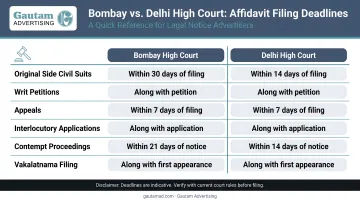
Missing these deadlines carries real risk — courts routinely treat unfiled counter-affidavits as an admission that the applicant's facts stand uncontroverted.
Notice of Motion vs. Related Legal Terms
Notice of Motion vs. Chamber Summons
Historically, Bombay High Court distinguished between these two:
| Feature | Notice of Motion | Chamber Summons |
|---|---|---|
| Nature of relief | Substantive interim relief (injunctions) | Procedural matters (amendments) |
| Heard by | Court (open court) | Judge in Chambers |
| Notice requirement | Public notice to opposite party | No public notice required |
| Current status | Both consolidated under Chapter IXA | Both consolidated under Chapter IXA |
After the 2018 amendments consolidating both under Chapter IXA, the distinction is now largely formal. As legal commentator Abhinav Chandrachud noted, "it would be rare to see a judge moved by a technical argument that a party filed a Notice of Motion instead of a Chamber Summons."
Notice of Motion vs. Petition
The distinction remains critical:
- Petition: Initiates proceedings or invokes court's jurisdiction on the substantive main question (writ petition under Article 226, civil misc. petition)
- Notice of Motion: Filed within existing proceedings to seek interim or procedural relief
Filing the wrong document can result in the court rejecting the application outright — and beyond the procedural delay, it also raises a more fundamental question litigants often overlook: what does filing the right document actually get you?
Common Misconception About Automatic Relief
Many litigants assume that once a Notice of Motion is filed, the court automatically grants the relief requested. This assumption is wrong. The motion is a request, not a guarantee — the court independently evaluates whether the applicant has satisfied the legal tests (prima facie case, balance of convenience, irreparable harm for injunctions) before passing any order. Filing establishes the application; proving entitlement to relief is an entirely separate hurdle.
Frequently Asked Questions
What is a notice of motion in the High Court?
A Notice of Motion is a formal application filed in a High Court proceeding, giving advance notice to the court and the opposite party that the applicant will seek a specific order or relief on a particular date. It is governed by the CPC and the relevant High Court's Original Side Rules.
What does 'motion' mean in a court case?
A motion is a formal written request made to a judge asking for a ruling or order on a specific issue within a case. It is an interlocutory tool used to resolve procedural or interim matters without deciding the main suit or appeal.
What is the difference between a petition and a notice of motion?
A petition initiates a proceeding or invokes the court's jurisdiction on the substantive main question, while a Notice of Motion is filed within an existing case to seek interim or procedural relief. They are distinct in purpose, timing, and legal effect.
What is the difference between chamber summons and notice of motion?
A chamber summons is heard privately in the judge's chamber for less contentious procedural matters, whereas a Notice of Motion is heard in open court with formal advance notice to the opposite party. The choice depends on the nature of the relief and the court's rules.
What is notice of motion in the Delhi High Court?
In the Delhi High Court, a Notice of Motion is termed an "interlocutory application" under the Delhi High Court (Original Side) Rules, 2018. It is used in civil suits to seek interim reliefs such as injunctions or stay orders, with a 4-day deadline for filing counter-affidavits.
Who files the notice of motion?
Either party (plaintiff/petitioner or defendant/respondent) can file a Notice of Motion, depending on who is seeking the relief. It is most commonly filed by the party seeking interim protection or a specific procedural order.
Understanding the Notice of Motion procedure equips litigants, legal professionals, and businesses to navigate High Court proceedings with confidence. By following proper drafting, filing, service, and hearing protocols, and satisfying the relevant legal tests, parties can secure the interim orders needed to protect their rights during ongoing litigation.