
Introduction
A case stalls. The defendant can't be located. Direct service has failed. In situations like this — property disputes, summons, probate, name changes — publishing a court notice in a newspaper is not just an option under Indian law, it is often the only path forward.
Publishing one is rarely as simple as it looks. Errors in newspaper selection, notice format, or documentation can invalidate the entire publication — delaying proceedings by weeks or months.
Courts have rejected notices published in newspapers with insufficient circulation, papers not on approved lists, and cases where the affidavit of publication was never filed.
This guide covers the types of notices that require newspaper publication, the step-by-step process specific to Indian law, what affects cost and validity, and how to avoid common mistakes that can derail your legal case.
Key Takeaways
- Publish court notices only in RNI-registered newspapers circulating in the defendant's jurisdiction
- Have an advocate draft, sign, and certify the notice before submitting it to the newspaper
- Include the case number, court name, party details, and applicable legal provisions in the notice
- Courts order publication only after you document failed direct service attempts
- File the proof of publication affidavit with the court to complete the legal process
Types of Court Notices That Require Newspaper Publication in India
Indian law mandates newspaper publication for specific legal situations under multiple statutes including the Code of Civil Procedure (CPC), Indian Succession Act, Companies Act, and Insolvency and Bankruptcy Code. Each framework serves distinct procedural purposes.
Court Summons and Substituted Service (CPC Order V Rule 20)
When a defendant cannot be served directly — because they're evading service, have moved without leaving a forwarding address, or cannot be located — CPC Order V Rule 20 allows the court to order substituted service through newspaper publication. This is a last-resort measure, not a default option.
The CPC explicitly requires publication in "a daily newspaper circulating in the locality" where the defendant last resided or worked. Before granting this order, courts require documented evidence of failed personal service attempts, including:
- Returned mail with postal endorsements
- Process server affidavits detailing attempts
- Witness attestations confirming the defendant's absence
Property and Real Estate Notices
Public notices for property purchase, transfer, sale under power of attorney, or disputed titles serve two purposes. They establish a public record of transaction intent and invite claims or objections from interested parties — both essential for protecting the buyer in high-value deals. Most parties publish these voluntarily, typically in at least one widely circulated local newspaper, before completing the transaction.
Probate, Succession, and Estate Notices
Section 283 of the Indian Succession Act, 1925 empowers District Judges to issue citations calling upon all persons claiming interest in a deceased person's estate. Courts universally interpret "otherwise published" to include newspaper publication — typically in one English and one vernacular newspaper — to notify creditors and claimants before granting probate or letters of administration.
Name Change and Civil Notices
Individuals legally changing their name must publish in newspapers as a mandatory prerequisite before obtaining Gazette notification. The Department of Publication requires advertisement in "one of the daily local leading newspapers" with the person's father's/husband's name and residential address.
Corporate and Insolvency Notices
Under the Insolvency and Bankruptcy Code (IBC) 2016, IBBI Regulation 6 mandates public announcements for Corporate Insolvency Resolution Process (CIRP) in "one English and one regional language newspaper with wide circulation" at the corporate debtor's registered office location. Two additional statutes impose parallel requirements:
- Companies Act 2013, Section 230(3): merger and scheme notices must be published at least 30 days before any NCLT-ordered meeting
- SEBI regulations: listed companies must publish financial results and material disclosures in specified dailies within prescribed timelines
Step-by-Step: How to Publish a Court Notice in a Newspaper
Step 1: Consult Your Advocate and Identify the Legal Requirement
Engage a qualified advocate who will determine which specific statute or court order requires newspaper publication, and what content, language, and format the notice must contain. Courts and newspapers reject self-drafted notices that lack advocate certification for legal notice categories.
Your advocate will identify whether publication is mandated under CPC Order V Rule 20 (substituted service), Indian Succession Act Section 283 (probate), or another legal framework — each carries distinct procedural requirements.
Step 2: Obtain Court Authorization Where Required
For substituted service under CPC Order V Rule 20, you must file a formal application before the court with documented evidence of failed direct service attempts. Delhi High Court rules specify that newspaper publication "should only be adopted as a last resort after all other prescribed methods of service have failed."
Required evidence includes:
- Process server's reports documenting multiple failed attempts
- Returned postal receipts showing undelivered mail
- Witness attestations (different witnesses for each attempt)
- Evidence the defendant is "keeping out of the way" to avoid service
Courts have set aside publications where evidence of failed service was insufficient or where summons were sent to incorrect addresses. For property notices or name changes, a court order may not be needed, but advocate certification remains mandatory.
Step 3: Draft the Notice in the Correct Format
Every court notice must include specific mandatory elements — omitting any one can invalidate the publication.
Mandatory Elements:
- Date of issue
- Full names and addresses of all parties (plaintiff and defendant)
- Case number and year
- Court name and jurisdiction
- Legal provision under which notice is issued (e.g., "Order V Rule 20 CPC")
- Nature of the action, demand, or claim
- Response deadline or next hearing date
- Consequences of non-appearance
- Advocate's name, contact details, and signature
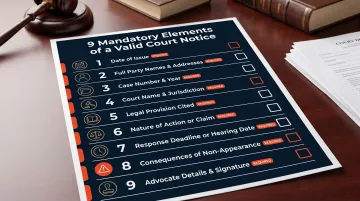
Incorrect or incomplete drafting is the leading cause of notice rejection. Courts in multiple jurisdictions have rejected notices lacking case numbers, using outdated party information, or failing to cite the applicable legal provision.
Step 4: Select a Qualified Newspaper and Submit Your Notice
The newspaper must meet three critical criteria: RNI (Registrar of Newspapers for India) registration, sufficient circulation in the jurisdiction where the matter is pending, and inclusion on the relevant court's approved publication list where applicable.
Dual-Language Requirements:
Many Indian court notices require publication in both an English newspaper and a regional language newspaper. For example, a Mumbai case typically requires publication in an English daily and a Marathi or Gujarati paper. IBBI Regulation 6 explicitly mandates dual-language publication for insolvency announcements.
Court-Approved Publication Lists:
Delhi District Courts maintain a list of 53 approved daily newspapers in 14 languages for court notice publication. Punjab & Haryana High Court similarly circulates revised approved newspaper lists to subordinate courts. Publishing in a non-approved newspaper risks invalidation — even if the paper is otherwise credible.
Working with an established INS-accredited agency like Gautam Advertising — which has maintained relationships with 10,000+ publications across India since 1967 — ensures the correct newspapers are selected for the relevant jurisdiction without the risk of selecting a non-compliant publication. INS accreditation since 1976 signals verified intermediary status to both courts and publications.
Step 5: Obtain the Affidavit of Publication and File It with the Court
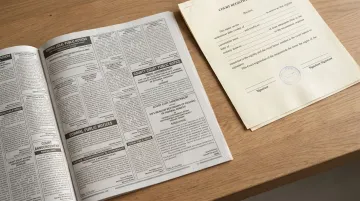
Once the notice has run for the required number of days or issues, the newspaper issues a "proof of publication" or affidavit confirming the dates and content published — this filing is a mandatory procedural step, not a formality.
CPC Order V Rule 19 requires affidavit verification of service. Delhi High Court Rules explicitly mandate that the process-server's affidavit must be on file before any ex-parte order is passed. Without this affidavit on record, the court cannot treat service as complete, and the publication has no procedural effect on the case.
What You Need Before Publishing a Court Notice
Submitting incomplete documentation is the most common reason for delays — courts and newspapers reject notices that lack required supporting documents. Gather everything below before approaching any publication.
Documents and Compliance Checklist
Before submitting your notice, ensure you have:
- Advocate-certified draft notice with official stamp and signature
- Court order directing publication (required for substituted service under Order V Rule 20)
- Proof of failed service attempts (process server reports, returned mail receipts, witness attestations)
- Case-related documents including case number, party names, and court jurisdiction details
- Language version of the notice (English + regional language if required by court order or statute)
Newspaper Qualification Check
Before booking, verify:
- The newspaper is RNI-registered under the Press and Registration of Books Act, 1867
- The newspaper has sufficient circulation in the relevant district or state where the defendant last resided or the matter is pending
- The newspaper is published in the required language (vernacular newspapers are typically required or preferred by courts)
- The newspaper appears on the court's approved publication list (check with the relevant High Court or district court registry)
The circulation requirement is not a formality — courts have invalidated notices published in papers that did not reach the defendant's area. In Kamlabai vs Dhula (MP HC, 1958), publication in a Hindi daily from Indore was held insufficient when the defendant lived in a different district with no evidence the paper circulated there.
What Determines the Cost and Validity of Your Court Notice Ad
Cost is not standardized — it varies based on several factors, and understanding them helps avoid overpaying or publishing in an unsuitable newspaper.
Size and Word Count of the Notice
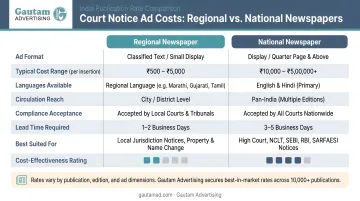
Most legal notice ads are charged per line or per square centimetre. A detailed property or probate notice spanning 20-30 lines will cost significantly more than a brief 8-10 line summons notice. Classified text ads (the most common format for court notices) typically have a minimum base charge (e.g., 5 lines) with additional charges per line thereafter.
Newspaper Circulation and Reach
National English dailies (Times of India, Hindustan Times, Indian Express) charge a premium over regional or local papers. For many court notices, a regional language paper with adequate local circulation is legally sufficient and far more cost-effective.
Publishing in the Times of India Delhi edition, for instance, may cost ₹5,000-₹6,000 for a basic classified notice. The same notice in a widely circulated Marathi or Gujarati regional daily typically runs ₹2,000-₹3,000.
The regional paper may actually be the stronger legal choice if the defendant last resided in an area where that language is predominantly spoken.
Number of Insertions Required
Court orders often require publication once, twice, or on three consecutive occasions depending on the case. Missing a required insertion date can force the entire process to restart — doubling or tripling the final expense.
A few things to confirm before booking:
- The CPC does not specify a mandatory insertion count — this comes from the specific court order and applicable High Court rules
- Your advocate should clarify the exact number of insertions required
- Confirm dates in advance; late changes to booking schedules can affect legal validity
Jurisdiction-Specific Requirements
Different High Courts maintain distinct rules and approved newspaper lists. The Punjab & Haryana High Court Rules state that judges personally select the newspaper for court notices and prefer vernacular papers unless there is "good reason to suppose" the person reads English.
Important: Publishing in a newspaper not on the court's approved list — even a credible, RNI-registered publication — can result in the notice being rejected outright. Verify the approved newspaper list with the court registry before placing any booking.
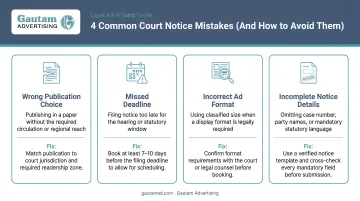
Common Mistakes That Can Invalidate Your Court Notice
Publishing in a Newspaper That Lacks RNI Registration or Sufficient Circulation
In Hukum Chand Yadav vs Bombay Mercantile (Delhi HC, 2017), the court set aside service because publication was in an "unknown newspaper" with "almost nil circulation." The newspaper used (Rashtriya Sahara) did not meet the circulation threshold required for the defendant's locality.
If publication fails to actually inform the defendant, courts will not treat it as valid service. Always verify RNI registration and circulation data before selecting a newspaper.
Submitting the Notice Without Advocate Certification or With an Incorrect Case Number
Courts treat uncertified notices as informal communications, not legal service. Even minor omissions such as a missing or incorrect case number can invalidate the publication. The notice must match the court's records exactly — including case number, year, party names, and court jurisdiction.
Missing the Required Number of Consecutive Publication Dates
Missing even one insertion when the court order mandates consecutive publications can require restarting the entire process — adding weeks to your timeline and doubling costs. Confirm guaranteed publication dates with your newspaper or agency before the campaign begins.
Failing to Collect and File the Affidavit of Publication
Without the affidavit of publication on file, the notice carries no procedural weight. Delhi High Court Rules require this affidavit before any ex-parte order can be passed. Collect it immediately after the final insertion runs and submit it to the court without delay.
To avoid these pitfalls across all four areas, keep this checklist handy before filing:
- Confirm the newspaper holds valid RNI registration and adequate local circulation
- Verify advocate certification and cross-check all case details against court records
- Lock in guaranteed publication dates covering every required insertion
- Collect the affidavit of publication the day the final insertion runs
Frequently Asked Questions
How much does it cost to publish a court notice in a newspaper?
Cost varies based on the newspaper's circulation (national vs regional), the size and word count of the notice, and the number of required insertions. Regional language papers are typically more affordable (₹2,000–₹3,000 for a basic notice) than national English dailies (₹5,000–₹6,000+) and may be legally sufficient for local jurisdictions.
How do I publish a court notice or summons in a newspaper?
The process involves five steps:
- Have the notice drafted and certified by an advocate
- Obtain court permission if required (particularly for substituted service under Order V Rule 20)
- Select an RNI-registered newspaper with circulation in the relevant jurisdiction
- Submit the notice with all required documents
- Collect the affidavit of publication to file with the court
What is a legal notice in India?
A legal notice is a formal written communication sent under Section 80 of the CPC or other statutes, informing the opposite party of an intended legal action and giving them an opportunity to settle before litigation begins.
What are the different types of notices in law — public, legal, and court notices?
Court notices are summons or orders issued for a specific pending case. Legal notices are formal pre-suit demands drafted by an advocate (such as a Section 80 CPC notice). Public notices are announcements of property transactions, name changes, or similar civil matters inviting claims or objections from the general public.
Can a court notice be displayed on a notice board instead of being published in a newspaper?
Under Indian law, notice board display at the court-house is sometimes permitted as a supplementary method under CPC Order V Rule 20, but it does not replace newspaper publication for substituted service. Both methods may be ordered simultaneously, and newspaper publication carries stronger evidentiary weight and broader reach.
What happens if I receive a legal notice?
Do not ignore it. Engage an advocate immediately to review the claims, respond formally within the stated deadline (typically 15-30 days), and retain all documentation. Non-response can be used as evidence of admission or awareness in subsequent proceedings, and may lead to an ex-parte court order being passed against you.