
Introduction
A digital campaign can go live in an afternoon, reach a precisely defined audience, and report clicks within minutes. A newspaper advertisement takes longer to plan, yet it lands in a reader's hands with a credibility that a banner ad rarely matches.
Choosing between the two isn't cosmetic. Media selection affects audience quality, campaign cost, how well you can track response, and whether attention actually converts into enquiries or sales.
India's advertising market reflects this split: digital accounted for an estimated 59% of total AdEx in 2025, with print at 14%, according to Dentsu's 2026 report. That gap doesn't settle which channel performs better for your business.
There's no universal winner here. The right answer depends on your objective, audience, budget, timeline, and how you plan to measure results.
Key Takeaways
- Digital ads suit fast launches, precise targeting, flexible budgets, and measurable online actions.
- Print ads build credibility, local or language-based reach, and work well for high-consideration decisions.
- Compare channels using the same outcome, such as qualified leads or store visits, not impressions alone.
- QR codes, unique URLs, and tracked phone numbers can connect print visibility to digital measurement.
- Test and optimise based on your campaign brief rather than assuming one medium always wins.
Digital Ads vs Print Ads: Quick Comparison
Cost and budget flexibility
Digital advertising runs on auction-based or platform-based buying. Google, for instance, runs a live auction every time ad space becomes available, charging per click or per thousand viewable impressions. Budgets adjust daily, though you still need to factor in creative production, landing-page development, and agency fees.
Print advertising follows a published rate card. Costs vary by:
- Ad size (full page, half page, quarter page, or classified)
- Colour versus black and white
- Placement (centrespread, front page, specific section)
- Edition and frequency of insertion
Always verify current rates and circulation directly with the publication, since rate cards are revised periodically.
Reach and audience targeting
Digital platforms allow targeting by demographics, geography, interests, browsing behaviour, device type, keywords, and remarketing lists. India's internet base is large, but platform algorithms, privacy restrictions, and data quality can limit how precisely you actually reach the people you want.
Print targets through a different lens: newspaper edition, language publication, readership profile, specialist magazine section, or a local daily that covers one neighbourhood. A Gujarati-language newspaper, for example, reaches a specific linguistic and cultural audience no algorithm can replicate.
Speed, flexibility, and measurement
Digital ads launch fast. You can swap creative, run A/B tests, and reallocate budget mid-campaign. Print requires longer planning and production lead times and follows a fixed publication schedule, but it offers a predictable, trusted editorial environment that digital feed placements rarely match.
On measurement, digital gives you impressions, clicks, click-through rate, cost per acquisition, and post-click behaviour. Print relies on circulation data, enquiry volume, coupon codes, QR scans, and call tracking. Both work, but only when metrics are defined consistently before you compare them.
Trust, attention, and recall
A 2020 ASCI and Nielsen study found that 86% of Indian respondents trusted newspaper advertisements, compared with 75% for search-engine ads and 62% for online banner ads, based on a telephone survey of over 2,000 people.
The study measured trust in advertisements specifically, not news credibility, and the data is several years old. Even so, physical ads carry a perceived permanence and editorial association that digital formats struggle to replicate, especially as banner blindness and ad blocking grow more common.
In short: digital wins on speed and granularity; print wins on trust and focused reach. Which matters more depends entirely on your campaign goal, covered in detail below.

What Are Digital and Print Ads?
Digital Advertising
Digital advertising means paid promotion delivered through internet-connected devices and platforms. This is distinct from organic reach, unpaid SEO, or general social media posting that isn't boosted with ad spend.
Common formats include:
- Search ads and shopping ads
- Social media and display/banner ads
- Video and native ads
- Programmatic, OTT, and CTV placements
- RCS (Rich Communication Services) messaging ads
Gautam Advertising's digital services cover several of these, with programmatic buying that targets by demographic, interest, socio-economic class, geofence, and retargeting lists. OTT and CTV placements pair streaming reach with precise audience selection.
The operational upside is real: fast deployment, creative testing, retargeting, and optimisation toward business outcomes such as leads, website enquiries, or app registrations. The downside includes competitive auctions, invalid traffic, creative fatigue, and the risk of chasing clicks instead of qualified outcomes.
Use Cases of Digital Ads
Digital ads work best for time-sensitive offers, ecommerce campaigns, geographically spread audiences, and campaigns needing frequent creative changes.
Bosch India, for example, used Amazon's DSP to run audience-based video and display advertising for its dishwasher line. The brand tracked sales and return on ad spend directly through the platform over a four-week festive window, according to Amazon's case study. That's a single campaign result, not an industry benchmark, but it shows how digital attribution works in practice.
Print Advertising
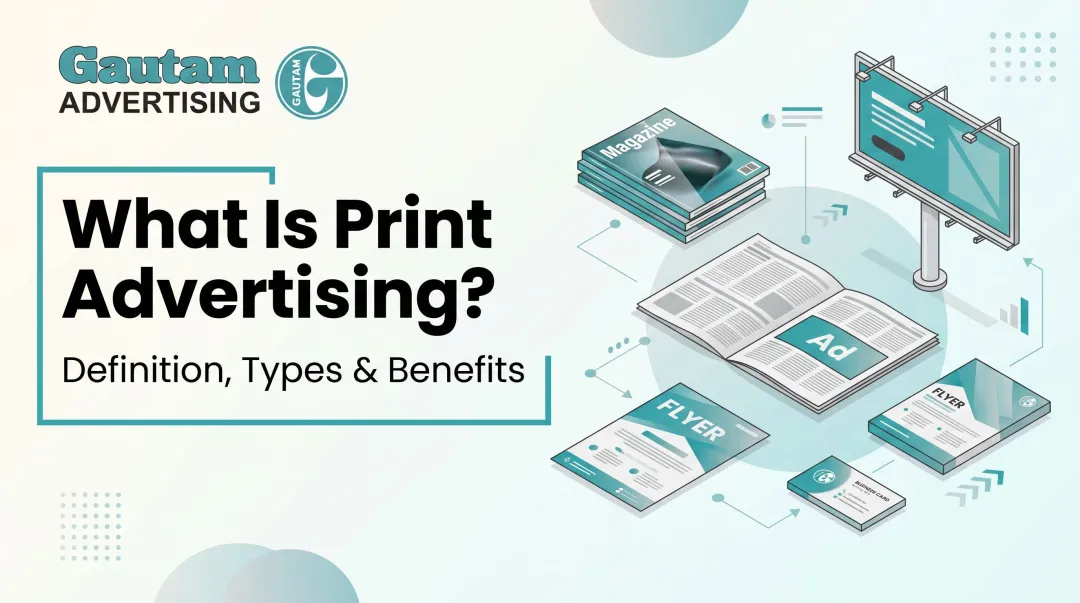
Print advertising covers paid promotional content in physical formats: newspapers, magazines, brochures, flyers, inserts, and classified sections. Indian newspaper advertising typically splits into three formats: classified text, classified display, and full display ads.
Core strengths of print:
- Physical visibility and tangibility
- Publication credibility and editorial context
- Section and edition targeting (local, regional, national, or language-specific)
- Repeat exposure through retained copies
Limitations exist too. Lead times are longer, creative is fixed once printed, individual-level attribution is harder, and reach is bound by circulation. Gautam Advertising's media planning process addresses this by evaluating five factors before booking: newspaper selection, circulation, readership, ad format, and frequency.
Use Cases of Print Ads
Print suits financial results, statutory notices, real estate, recruitment, matrimonial listings, and campaigns targeting a defined readership.
One illustrative case: a client working with Gautam Advertising ran a flat-sale advertisement in a single newspaper for one day and reported a sale shortly after. Even modest, well-placed classified ads can produce results in high-consideration categories like property.
Digital Ads vs Print Ads: What Is Better?
"Most effective" only means something when it's tied to a specific objective, audience, and conversion event. Reach and clicks alone don't answer the question.
Choose digital ads when:
- You need rapid testing and measurable online actions
- Your audience is spread across regions or highly online
- You need granular segmentation or retargeting
- Budget needs day-to-day flexibility
Choose print ads when:
- Credibility and trust matter more than speed
- Your audience is local or language-specific
- You're making a formal announcement (legal notice, financial result, recruitment listing)
- You want physical brand presence in a focused editorial environment
Comparing by campaign objective
| Objective | What to evaluate |
|---|---|
| Awareness | Qualified reach, frequency, attention, and the relevance of the surrounding editorial or platform environment |
| Lead generation or sales | Cost per qualified lead, conversion rate, customer acquisition cost, using equivalent tracking windows |
| Trust and reputation | Publication credibility, message context, and creative quality, rather than clicks alone |
Before choosing, run through a quick checklist:
- Audience profile and campaign geography
- Language, budget, and urgency
- Creative format and call to action
- Sales cycle and what you can actually track
Often, the smartest move is a hybrid: use print to build awareness or trust, then capture and nurture demand digitally through QR codes, landing pages, retargeting, or search.

This is where a media-planning partner like Gautam Advertising fits. With INS accreditation since 1976, access to 10,000+ publications, and both print and digital capabilities under one roof, the agency helps brands select the right publication, negotiate rates, and connect print placements to trackable digital response. No agency can honestly promise guaranteed outcomes, and that clarity matters when you plan spend.
Real-World Examples and Campaign Scenarios
Print-led: a property sale through one classified ad
A Gautam Advertising client, Sandip Mathuria, placed a flat-sale advertisement in a single newspaper for one day. The ad went through two or three creative revisions and was kept deliberately low-cost. The flat sold shortly after the ad ran. The case shows why classified ads still work for high-consideration, local categories like real estate.
Digital-led: audience-based buying for measurable sales
Consumer brands often use retail media platforms for festive-season campaigns. They pair awareness-stage video with performance-focused display, then track purchases through the platform's own attribution dashboard.
That model is locked to the platform's ecosystem, so results do not always transfer to performance on other channels.
Integrated: print driving a digital experience
ITC Classmate ran a back-to-school print campaign where a QR code embedded in the advertisement opened an augmented-reality experience letting consumers explore the product range. The campaign generated more than 30,000 scans, with users spending an average of two minutes inside the virtual experience, according to ITC's official case study.

It is a clear Indian example of print driving measurable digital interaction. Scans still measure engagement, not confirmed sales.
The takeaway:
- Fast, trackable transaction: lean digital
- Trust or a defined local audience: lean print
- Need both: link print to digital with a QR code or tracked URL and measure one funnel
Conclusion
Digital ads are often strongest for speed, precise targeting, rapid testing, and measurable online actions. Print ads can be strongest for trust, focused publication audiences, formal communication, and a physical presence that lingers after the page is turned.
Neither channel wins every campaign. The better choice is the one tied to a clear business objective and tracked with comparable outcome metrics.
For many Indian brands, a coordinated print-and-digital mix (credibility from one channel, measurable follow-up from the other) delivers more than either medium running alone.
Frequently Asked Questions
What are types of digital advertising?
Digital advertising includes search ads, social media ads, display and banner ads, video ads, native ads, shopping ads, and programmatic or OTT/CTV placements. The best type depends on your campaign objective and audience behaviour.
What are the different types of print advertising?
Print advertising includes newspaper display ads, classified ads, magazine ads, inserts, supplements, brochures, flyers, and local or language-specific publication placements.
What are the 5 main advertising techniques?
Five commonly used techniques are emotional appeal, social proof or testimonials, problem-solution messaging, scarcity or urgency, and informative or educational messaging. All five can be applied in both print and digital formats.
Is digital advertising more cost-effective than print advertising?
It depends on your audience, objective, buying model, and creative costs. Rather than comparing media price alone, compare cost per qualified outcome, such as cost per lead or cost per enquiry, across both channels.
How can I measure the effectiveness of a print advertisement?
Use QR codes, personalised URLs, unique offer codes, or tracked phone numbers within the ad itself. Match enquiry volume or sales spikes against the publication date and circulation data for a fuller picture.
Should a business use digital ads and print ads together?
Yes, in many cases. Print can build awareness and trust, while digital captures, retargets, and measures the resulting response. Coordinate the message, offer, and tracking links across both for a cleaner read on performance.