
Introduction
Every advertising campaign starts with the same question: where should this message actually appear? That's the job of advertising media, the channels businesses use to put products, services, or brand messages in front of a chosen audience.
In India, this choice is rarely simple. A business might need local reach in Pune, mass visibility during a festival season, or precise digital targeting for a product launch, all while working within a fixed budget and timeline.
Advertising revenue in India grew 8.1% in 2024, according to FICCI-EY's 2025 report, with spending shifting across print, broadcast, digital, and outdoor in different ways. This guide walks through seven major media types, their strengths and limits, and how to pick the right mix for your campaign.
Key Takeaways
- Advertising media are the channels that carry promotional messages, distinct from the creative formats used within them.
- Seven main categories exist: print, broadcast, digital, outdoor, direct mail, ambient, and specialty media.
- No single medium works for every campaign; the right pick depends on audience, objective, geography, and budget.
- Combining offline and digital media often builds awareness while creating trackable response paths.
What Is Advertising Media?
Advertising media are the communication channels businesses pay to use when delivering promotional messages to potential or existing customers. A medium can carry text, images, audio, video, interactive content, physical items, or an experience.
It helps to separate three related terms:
- Medium – the broad channel type, such as print or broadcast
- Platform or publication – the specific channel, such as The Times of India or Zee TV
- Ad format – the creative unit itself, such as a classified listing or a display banner
How Media Connects to the Customer Journey
Advertisers pick media based on where their audience is, when they're paying attention, and what stage of buying they're in.
A few Indian examples make this concrete:
- A property listing in a regional newspaper's real estate section
- A radio spot for a local coaching institute during morning drive time
- A search ad triggered when someone looks up "best accountant near me"
- A billboard placed along a high-traffic flyover route
Each of these picks a medium that fits the message and the moment.
Why Is Advertising Media Important in the Field of Marketing?
Media choice directly shapes campaign outcomes, whether that's awareness, website visits, footfall, recruitment applications, or sales. Pick the wrong channel and you get wasted impressions, poor audience fit, and results that are hard to measure.
Digital accounted for 55% of India's total advertising revenue in 2024, growing 17% year-on-year, while print advertising still grew 1% despite the broader shift, according to the FICCI-EY 2025 report. That figure is not proof one medium beats another. It shows spending patterns are changing while multiple channels still deliver results.

Media selection gives businesses control over:
- Audience scope – who sees the message and how precisely
- Geographic coverage – neighbourhood, city, state, or national reach
- Frequency and timing – how often and when the message appears
- Placement and presentation – position, size, and creative treatment
Sectors Where Media Planning Matters Most
Some industries carry higher stakes when it comes to channel selection:
- Real estate – needs local credibility plus visual impact
- Hospitality – benefits from seasonal and location-based targeting
- Education – relies on admission-cycle timing
- Finance and recruitment – require trust and broad reach
- Listed companies – face regulatory publication requirements for financial disclosures
Types of Advertising Media
Treat these seven categories as a practical framework, not a rigid classification. Some channels overlap. Digital out-of-home, for instance, sits between outdoor and digital media. Judge each by audience fit, format, reach, cost, timing, and how easily you can measure results.
Print Media
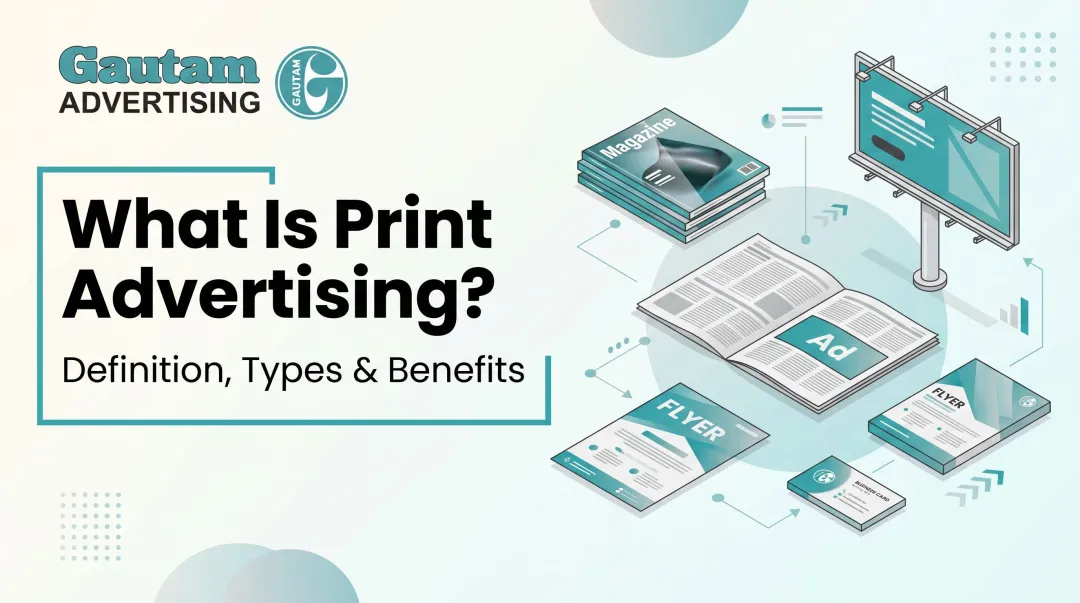
Print media covers advertising in physical publications, newspapers, magazines, brochures, leaflets, catalogues, and classified listings. Advertisers pick a publication, edition, position, size, and colour treatment to reach a relevant readership.
Strengths:
- Strong credibility and tangible visibility
- Local or language-based targeting
- Room for detailed information
- Well suited to property, recruitment, education, and financial notices
Trade-offs:
- Production deadlines limit last-minute changes
- Limited two-way interaction
- Clear response mechanism required, such as a QR code or phone number
Every Indian newspaper typically offers three ad formats:
- Classified text ads (charged by word or line)
- Classified display ads (charged per square centimetre, allowing logos and images)
- Full display ads (sold by page fraction)
Gautam Advertising has handled print-media planning and newspaper placement since 1967, working across local, regional, and national publications rather than defaulting to one standard title.
Broadcast Media
Broadcast media includes television, radio, cinema, and other scheduled audio or audiovisual programming. Television and video pair sight with sound; radio relies on voice, music, and sound effects alone.
Television's cumulative weekly reach stood at 753 million people in 2024, per BARC data cited in the FICCI-EY report, showing broadcast still commands mass attention.
Best fit:
- Mass awareness and product demonstrations
- Emotional storytelling
- Regional-language campaigns
- Time-sensitive offers
Limitations:
- Steep production costs
- Placement that isn't always precisely targeted
- Repeated airing needed to land the message
Digital or Online Media
Digital media spans search engines, websites, social networks, apps, streaming platforms, email, and marketplaces. Formats include search ads, display ads, social ads, video, native placements, influencer collaborations, programmatic buying, and retargeting.
India had 886 million active internet users in 2024, with 80% accessing the internet via their own mobile device, according to the IAMAI-Kantar report.
Strengths:
- Granular audience segmentation
- Fast launch and mid-campaign adjustment
- Trackable conversions and A/B testing
Trade-offs:
- Platform dependence
- Privacy and consent rules
- Ad fatigue
- Constant need for accurate tracking setups
Digital media is broader than social media alone. Gautam Advertising, for instance, runs campaigns across programmatic buying, OTT, and Connected TV, pairing television-style reach with digital targeting precision.
Outdoor or Out-of-Home Media
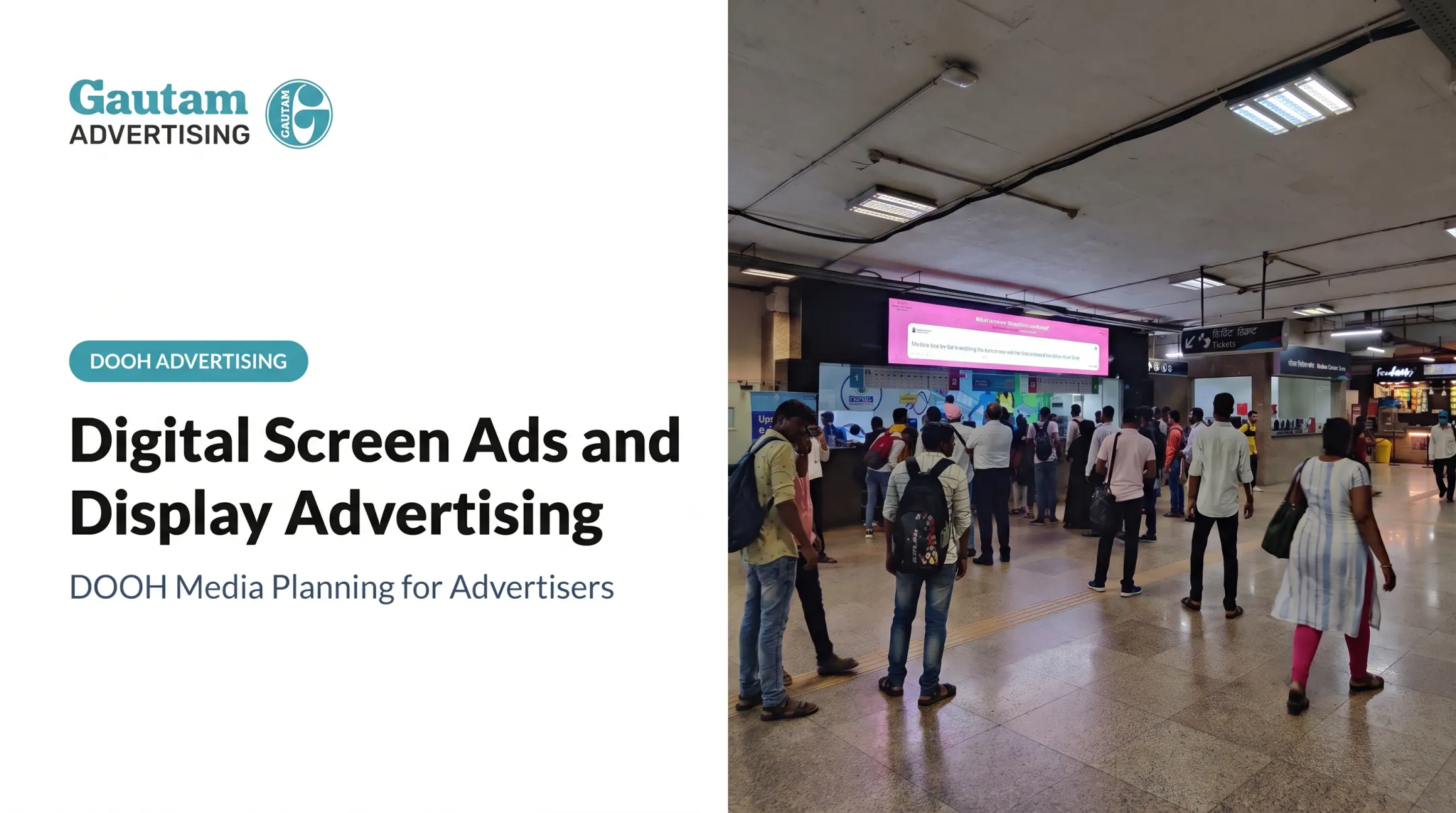
Outdoor media includes billboards, hoardings, transit ads, bus shelters, airport placements, and digital outdoor screens. Performance depends on location, visibility, traffic direction, dwell time, and message simplicity.
Out-of-home advertising revenue grew 10% in 2024, while digital OOH surged 78%, now making up 12% of segment revenue, up from 7% the year before, per the same FICCI-EY data.

Best fit:
- Local awareness
- Real estate, retail, and hospitality
- Reinforcement for campaigns already running elsewhere
Limitations:
- Short reading windows
- Location-specific reach
- Permission requirements
- Weak attribution unless you add a QR code, keyword, or phone number
Direct Mail and Addressed Print
Direct mail sends promotional material to selected households, businesses, or prospect lists, unlike general print ads placed for a broad readership.
Suitable uses:
- Invitations and catalogues
- Financial or educational offers
- Local promotions and corporate outreach
- Personalised follow-up communication
Trade-offs:
- List quality determines results
- Printing and delivery add cost
- Personal-data handling must stay within current compliance requirements
India's Digital Personal Data Protection Act applies to personal data collected digitally or digitised later, which matters for any mailing list stored electronically.
Ambient and Experiential Media
Ambient media places advertising in unexpected or context-specific spots such as building surfaces, lifts, washrooms, malls, packaging, or event spaces. The point is surprise and context, not a conventional placement.
Suitable uses:
- Product launches
- Lifestyle brands and entertainment promotion
- Campaigns designed for social sharing
Limitations:
- Restricted scale
- Permission hurdles
- Execution complexity
- Results that don't compare neatly against standard media metrics
Specialty or Promotional Media
Specialty media covers branded merchandise, pens, notebooks, bags, keyrings, apparel, and drinkware, given to customers, employees, or event attendees.
Best fit:
- Trade shows and corporate gifting
- Recruitment drives
- Customer-retention efforts
Trade-offs:
- Inventory, storage, and distribution costs add up
- Items retained without a response deliver little measurable value
Adding a trackable code or dedicated landing page helps connect the item to an actual enquiry.
How to Choose the Right Type of Advertising Media
The best medium depends on your campaign's purpose and audience, not on what's trending. Work through these factors before committing your budget:
- Campaign objective – awareness, enquiries, footfall, recruitment, sales, or reputation goals each point to different channels
- Target audience – consider demographics, language, occupation, media habits, and whether your audience is local, regional, or national
- Geography and scale – a neighbourhood publication serves a different purpose than a national newspaper or broadcast network
- Message and creative format – detailed text suits print or direct mail; demonstrations suit video; urgent short messages suit outdoor
- Budget and buying model – factor in media space, creative production, agency fees, and minimum spends, not just sticker prices
- Measurement and response – decide upfront how you'll evaluate results, through enquiries, QR scans, dedicated phone lines, or landing-page visits
Test a focused media mix first, then refine it using actual campaign evidence rather than committing an entire budget to an untested channel.

This is where media-planning expertise earns its keep. Gautam Advertising compares publication opportunities, negotiates placements, and builds tailored media plans across print, digital, and out-of-home channels, drawing on over 100 media partnerships and a network spanning 10,000+ publications worldwide.
What to Check Before Finalising a Type of Advertising Media
A few final checks separate a well-planned campaign from a wasted one.
- Don't chase the fashionable channel. A simpler medium that actually reaches your audience beats a trendy one that doesn't.
- Look past reach alone. Check audience relevance, frequency, placement quality, and whether the format suits your creative.
- Confirm the details upfront. Deadlines, specifications, permissions, brand-safety rules, and cancellation or make-good policies all matter before signing off.
- Build measurement in before launch. A distinct offer, URL, QR code, or campaign-specific phone number makes tracking possible from day one.
- Credit offline media fairly. Don't judge print or outdoor only by immediate online conversions; factor in assisted enquiries, branded search, and direct footfall too.
Regulatory compliance matters here as well. Listed companies, for example, must publish financial results within 48 hours of board approval, with a QR code and webpage link included in the advertisement, under SEBI's LODR regulations.
Similar sector-specific rules apply to real estate, recruitment, and public notices. Check current requirements before finalising any media buy.
Conclusion
Advertising media are the channels that carry your promotional message. Each of the seven categories (print, broadcast, digital, outdoor, direct mail, ambient, and specialty) serves different audience, creative, and measurement needs.
None of them is interchangeable. A property ad in a Mumbai newspaper works differently than a programmatic display campaign or a transit billboard. Picking between them should start with your objective and audience, not habit.
Before you lock a plan:
- Define clear campaign goals
- Set a measurable response method
- Weigh reach, cost, and creative trade-offs honestly
- Bring in professional media-planning guidance when the campaign spans multiple publications or channels
Frequently Asked Questions
What are the 7 main types of advertising media?
The seven types are print, broadcast, digital or online, outdoor or out-of-home, direct mail, ambient or experiential, and specialty or promotional media. Each serves different campaign objectives, from mass awareness to targeted, trackable response.
Which media is best for advertising?
There's no single best medium. The right choice depends on your audience, objective, geography, message, budget, timing, and how you plan to measure results. A coordinated mix often outperforms relying on one channel alone.
What is considered electronic media?
Electronic media refers to advertising delivered through electronically operated channels, including television, radio, websites, social platforms, mobile apps, streaming services, and digital screens, as opposed to paper-based formats.
What are the 5 types of electronic media and examples?
Five common categories: television (a product-launch commercial), radio (a brand jingle), internet or digital media (a search ad), cinema (a pre-film advertisement), and digital out-of-home (a mall screen ad).
What are four examples of electronic media advertising?
Four examples: a television commercial, a radio spot, a search or social-media ad, and a video advertisement running on a streaming platform or website.